- SST window
- At the sale or within 90 days (SSUTA 317.C)
- On audit
- 120 days after a request, with a good faith test (SSUTA 317.D)
- Blanket certificates
- No renewal while sales recur within 12 months in SST states
- Record periods
- 3 to 6 years where a state sets one
The checklist in order
A sale is taxable until the seller shows otherwise. The resale certificate is how the seller shows it, and the protection it gives depends on how it was taken. The Streamlined Sales and Use Tax Agreement, which 24 states follow, states the bargain plainly: each member state “shall relieve sellers that follow the requirements of this section from the tax otherwise applicable if it is determined that the purchaser improperly claimed an exemption and to hold the purchaser liable for the nonpayment of tax” (SSUTA 317.B). States outside the Agreement use other words for the same idea: California's regulation says a certificate taken on time, in proper form and in good faith “relieves the seller from liability for the sales tax and the duty of collecting the use tax” (Reg. 1668(a)).
The checks below follow the order in which a seller meets them: when the order comes in, when the certificate arrives, before the goods ship, and for years afterward. Each one links to the page that covers it state by state.
SSUTA Section 317 and Rule 317.1; SST Form F0003 seller's instructions; MTC uniform certificate FAQ; each state's rules. The amber step is the one an auditor tests first: a certificate that does not fit the buyer's business.
- Take the right document for the state the sale is sourced to: the state's own form, the document the state issued, or the buyer's permit where that is the document. See the state pages.
- Check that it is fully completed: every field the form asks for, the buyer's number, and a signature on paper. See what a valid certificate includes.
- Have it on time: at the sale, or within the state's window (90 days in SST states). See good faith and timing.
- Take it in good faith: the goods must be the kind this buyer resells.
- Verify the buyer's number where the state offers or requires a lookup. See every state's lookup.
- Keep it, on paper or electronically, for the state's record period. See records by state.
- Renew it where the state sets a term. See expiration by state.
Counts from each state's statutes, regulations, forms and pages, as on the state pages; SSUTA Section 317.C, 317.D and 317.F.
1. The right document for the state
States follow three models, and the first check is knowing which one applies. In 37 states the buyer fills out a form, usually the state's own (California's CDTFA-230, New York's ST-120, Texas Form 01-339) or a multistate form the state accepts. In 9 states and DC the state issues the document itself (AL, AK, DC, FL, LA, ME, NM, TN, WA): Florida, for example, says “you will be issued a new Annual Resale Certificate each year”. In Mississippi the buyer's sales tax permit is the proof (MS). Four states have no general sales tax (DE, MT, NH, OR), and Alaska's local taxes have their own remote seller certificate.
The model decides what the seller should hold. Where the buyer fills out a form, a permit number alone is not enough; Texas says “the customer's sales tax permit number or a copy of the customer's permit is not a substitute for a resale certificate and does not relieve a seller's responsibility for collecting sales tax”. Where the state issues the document, the seller holds a copy of it or a recorded check against the state's system.
The multistate forms widen the choice. The SST Certificate of Exemption, Form F0003, “are accepted by all 24 Streamlined member states.” The MTC uniform certificate lists most other states, each with its own note, and some states take neither. The multistate hub and out-of-state certificates cover which form works where.
2. Fully completed
A certificate with a blank field is not the document the relief rules describe. The SST rules list what the seller must get from a buyer claiming an exemption: “its name, address, type of business”, the reason for the exemption, the ID number the state requires, the state and country that issued it, and, “if a paper form is used, a signature of the purchaser” (Rule 317.1.A.1). A fully completed paper certificate “includes all information fields requested on the Streamlined Sales and Use Tax Agreement's Certificate of Exemption” (Rule 317.1.A.10.a).
Outside the SST states the list comes from the state's own regulation or form. California's Regulation 1668 names five essential elements, including the buyer's permit number and the words "for resale"; Arizona's form warns that “Incomplete Certificates are not considered to be accepted in good faith.” The valid certificate page sets the required fields side by side.
3. On time
The SST rule is two windows. The first is the sale itself or 90 days after it: the seller must obtain “a fully completed exemption certificate or capture the relevant data elements required under the Agreement at the time of sale or within 90 days subsequent to the date of sale” (Rule 317.1.A.1). The second opens on audit: a member state “shall provide the seller with 120 days subsequent to a request for substantiation by a member state” to get the certificate, now tested for good faith (SSUTA 317.D.1).
Other states set their own clocks. Pennsylvania wants the certificate “on or before the 60th day following the date of the sale or lease to which the certificate relates” (61 Pa. Code 32.2). California counts it as timely if taken before billing, within the normal billing cycle, or at or before delivery (Reg. 1668(a)). Washington allows “at the time of sale or within one hundred twenty days after the sale” (WAC 458-20-102). The good faith and timing page has the rule for every state.
4. In good faith
Good faith is the check a form cannot do for the seller. The SST Agreement defines it for certificates collected on audit: a certificate “taken in good faith which means that the seller obtain a certificate that claims an exemption that (i) was statutorily available on the date of the transaction in the jurisdiction where the transaction is sourced, (ii) could be applicable to the item being purchased, and (iii) is reasonable for the purchaser's type of business” (SSUTA 317.D.1.a). The MTC's FAQ puts the same idea in a seller's terms: “Seller must exercise care that the property or service being sold is of a type normally sold wholesale, resold, leased, rented or incorporated as an ingredient or component of a product manufactured by Buyer and then resold in the usual course of its business.”
In practice that means reading the certificate against the order. A restaurant supply house buying napkins for resale is ordinary; the same customer buying a delivery van on its blanket certificate is not. Some states hold sellers to more than good faith: Louisiana says “Any dealer making a sale for resale which is not in strict compliance with the rules and regulations shall be liable for and pay the tax.” (R.S. 47:301(10)(a)), and Illinois's note on the MTC form says good faith “is not the standard of care to be exercised by a retailer in Illinois”.
5. Verified where the state offers a lookup
33 states and DC name an official lookup in their own texts. In most of them the lookup is offered, not required. The SST rules go further and bar member states from making it a condition: “A member state shall not require a seller or a CSP to verify exemption numbers or whether a purchaser is required to be registered in the state.” (Rule 317.1.C.2). A few states make a check part of the rule: Colorado says “A seller must verify that the purchaser's sales tax license or exemption certificate is current and valid at the time of the sale.” (Rule 39-26-105-3(2)(a)). Washington and Florida let a recorded check stand in for a copy of the buyer's document. The verification page lists every state's lookup and what each one checks.
6. Kept for the record period
The certificate is the seller's evidence, so it has to survive as long as an audit can reach the sale. The SST Agreement requires that “The seller shall maintain proper records of exempt transactions and provide them to a member state when requested.” (SSUTA 317.A.6), and the rules tie the period to the state's general record rule (Rule 317.1.D.2). Where a state sets a number of years, it runs from 3 to 6; several states start the clock at the last sale or the last return the certificate covers, not the day it was signed. Paper is not required in most states. The records page has every state's period and when it starts.
7. Renewed on the state's cycle
Most certificates do not expire. The SST states may not ask a seller to renew a blanket certificate while sales continue: “a member state may not request from the seller renewal of blanket certificates or updates of exemption certificate information or data elements when there is a recurring business relationship between the buyer and seller” (SSUTA 317.F), and a recurring relationship means no more than twelve months between sales. A minority of states set a term. Florida's state-issued certificate lapses every year: “Annual Resale Certificates Expire on December 31”. Connecticut says “The certificate must be renewed at least every three years from the date it is issued.” Washington reseller permits run four years, or two for some businesses. The expiration page has all 51 rules in one table.
When a certificate fails
When the checks hold and the buyer still lied, the risk moves to the buyer. Form F0003 says “The purchaser is liable for any tax and interest, and possible civil and criminal penalties imposed by the state, if the purchaser is not eligible to claim this exemption.” Relief is lost when the seller is part of the problem: the SST relief “does not apply to a seller who fraudulently fails to collect tax”, nor to one who solicits buyers to claim an exemption unlawfully (SSUTA 317.B). On audit, the state carries the burden: “The state must establish that the seller had knowledge or had reason to know at the time the information was provided that the information was materially false.” (SSUTA 317.D.2).
When the checks do not hold, the seller owes the tax it did not collect. A late, incomplete or implausible certificate leaves the sale taxable, and a seller that finds a gap should collect the certificate now rather than wait for the audit request. Buyers' penalties for misuse are on the misuse penalties page; shipments to a customer's customer are on the drop shipments page.
Tools for this topic
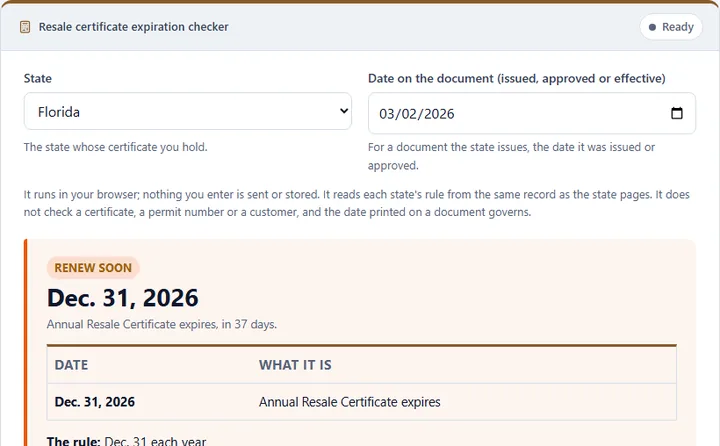
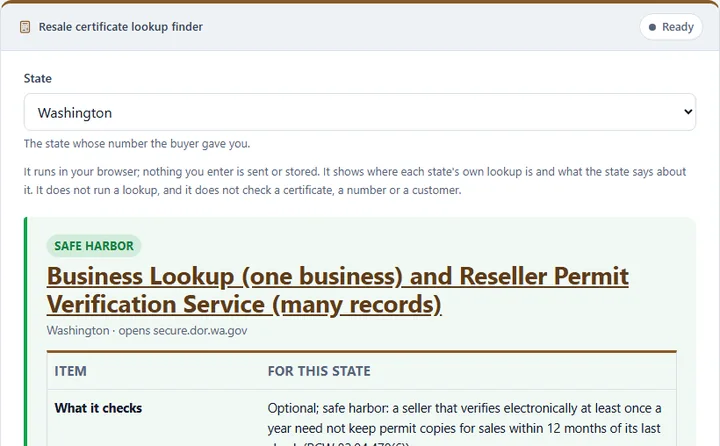
Templates
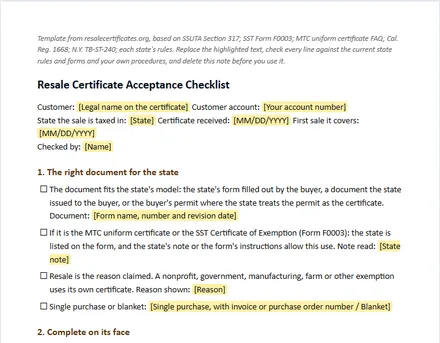
Acceptance checklist
The seller's checklist for each certificate: the right document, every field, on time, good faith, the state's lookup, the renewal date and records.
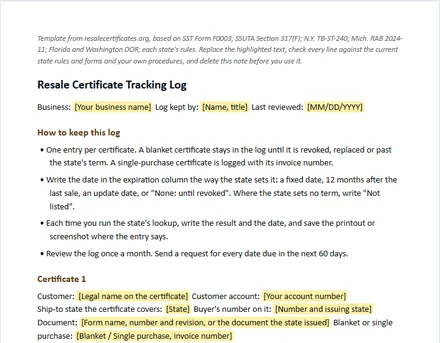
Tracking log
One entry per certificate: customer, ship-to state, document, dates, the expiration or renewal date, the lookup result, and where the copy is kept until when.
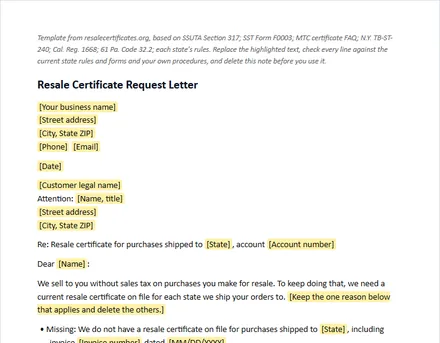
Request letter
A letter, and a short email, asking a customer for a missing, expired or updated resale certificate, with the document each state uses and when you need it.
Common questions
What does a seller need before making a tax-free sale for resale?
The right document for the state, fully completed, in hand at the sale or within the state's window, for goods the buyer would resell. In the SST states the seller is relieved if “The fully completed exemption certificate is provided to the seller at the time of sale or within 90 days subsequent to the date of sale”, absent fraud or solicitation.
Is a permit number enough without a certificate?
Not in the states where the buyer fills out a form. Texas says the permit number “is not a substitute for a resale certificate”. In the states that issue the document, such as Florida and Washington, the seller holds a copy or a recorded check against the state's system.
Do I have to verify every certificate?
Only where the state requires it. SST member states may not make the seller verify numbers (Rule 317.1.C.2). Colorado's rule requires a check at the sale, and Illinois's CRT-61 makes confirming an active number the seller's job. Elsewhere a lookup is offered, not required.
What happens if the buyer misuses a certificate I accepted properly?
In the SST states the buyer owes the tax: the states must “hold the purchaser liable for the nonpayment of tax” (SSUTA 317.B). Other states have similar rules, set out on each state page.
How long do I keep certificates?
For the state's record period, 3 to 6 years where a state sets one, and in several states counted from the last sale or return the certificate covers. The SST rule ties it to the state's general record period (Rule 317.1.D.2).
Sources
- Streamlined Sales Tax Governing Board, Streamlined Sales and Use Tax Agreement, Section 317 (amended through Oct. 15, 2026), and the Governing Board's Rules 317.1 and 317.2 (amended through Oct. 15, 2026)
- Streamlined Sales Tax Governing Board, Certificate of Exemption, Form F0003 (Revised 12/21/2021), and the exemption certificates page
- Multistate Tax Commission, Uniform Sales and Use Tax Resale Certificate (revised Oct. 14, 2022) and its FAQ
- California Regulation 1668; Colorado Rule 39-26-105-3; Texas Comptroller, resale certificate FAQ
- Each state's statutes, regulations, forms and pages, listed on its state page under resale certificates by state