- Who completes it
- The purchaser
- When
- Before billing, in the billing cycle, or at or before delivery
- Kept by
- The seller, at least 4 years; not sent to CDTFA
- Form revision
- REV. 1 (8-17)
- Pages
- 1
At a glance
CDTFA-230 is California's General Resale Certificate. The buyer fills it out and gives it to the seller; the seller keeps it and does not charge sales tax on the goods it covers. CDTFA does not issue it or collect it: “We do not provide resale certificates. However, a purchaser may download CDTFA-230, General Resale Certificate, on our website.” The rules behind it, for every California certificate, are on the California resale certificate page; this page walks the form itself.
- Who completes it. The purchaser, a business buying goods it will resell. The purchaser completes CDTFA-230 or a letter or purchase order with the essential elements; CDTFA does not issue resale certificates.
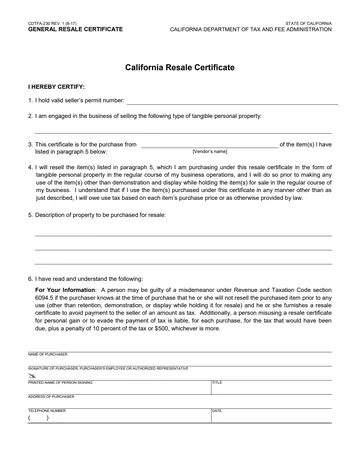
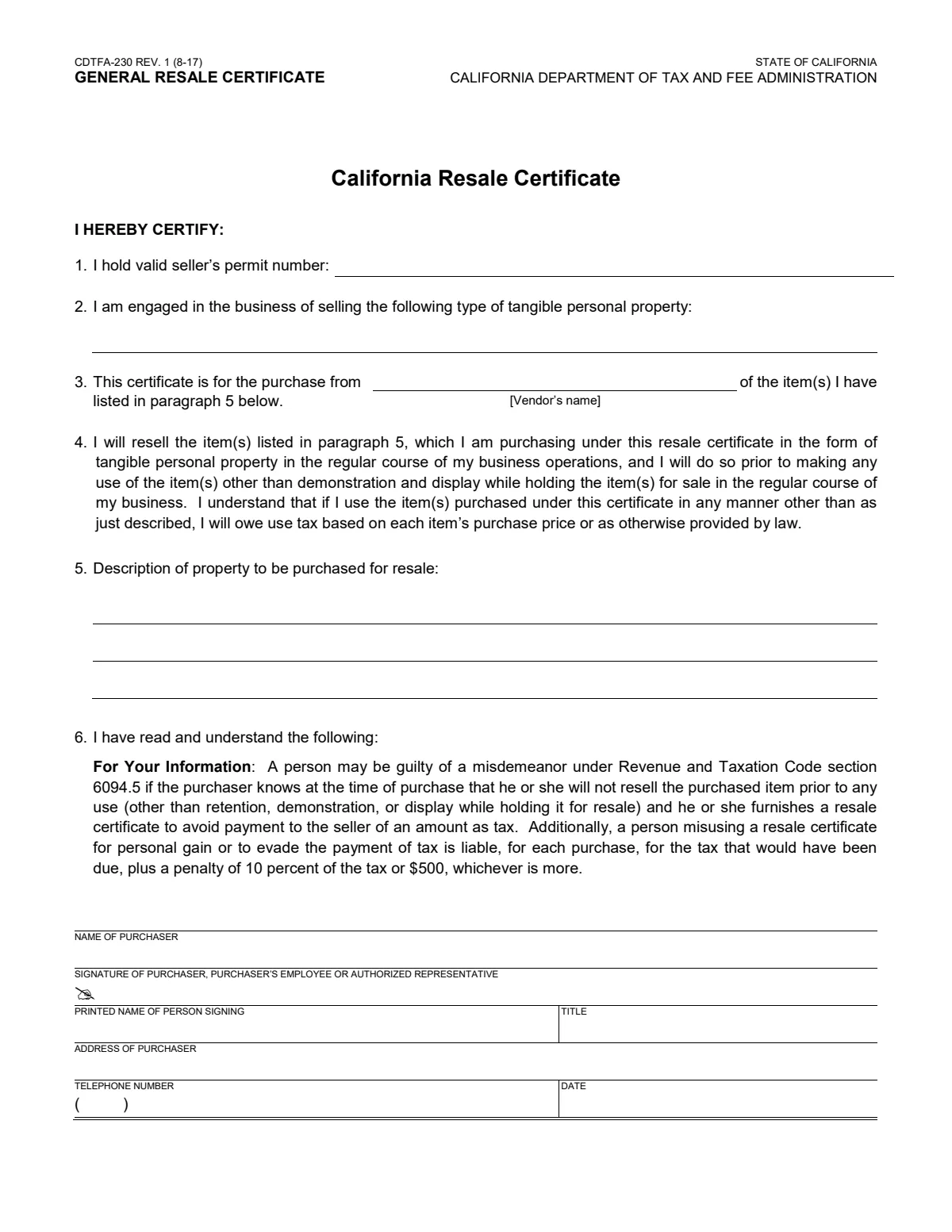
- The form. CDTFA-230, printed revision REV. 1 (8-17), one page with six numbered paragraphs and a signature block. The text follows Appendix A to Regulation 1668.
- When. Before billing, within the normal billing cycle, or at or before delivery (Reg. 1668(a)); a late certificate is not retroactive.
- How long it lasts. Until revoked in writing (Reg. 1668). There is no renewal date on the form.
- Where it goes. To the seller, who keeps it with its sales records. Keep resale certificates at least 4 years (Reg. 1698(i)); imaged or PDF copies allowed (Reg. 1698(h)).
The five essential elements
The form is optional. Regulation 1668 says any document, “such as a letter or purchase order, timely provided by the purchaser to the seller will be regarded as a resale certificate with respect to the sale of the property described in the document if it contains all of the following essential elements”: the signature, the buyer's name and address, the permit number (or the explanation), a statement that the property is bought for resale, and the date. CDTFA-230 is the safer route because the regulation recommends it: “in order to preclude potential controversy, the seller should timely obtain from the purchaser a certificate substantially in the form shown in Appendix A of this regulation.” CDTFA-230 is that Appendix A text on a form.
Each essential element maps to a place on the form: the signature line, the name and address lines, paragraph 1, paragraphs 4 and 5 (the "for resale" statement and the goods), and the date. The other lines (vendor's name, the type of business, title, phone) help the seller judge good faith but are not on the regulation's list.
Tap a box once for its note, again to jump to the line. Zoom in to read the small print.
Paragraphs 1 to 6
The six numbered paragraphs follow "I HEREBY CERTIFY." Paragraphs 1, 2, 3 and 5 take entries; 4 and 6 are printed statements the buyer adopts by signing.
| Line | As printed | What goes there |
|---|---|---|
| 1 | 1. I hold valid seller’s permit number: | The buyer's own California seller's permit number, one of the essential elements: “The number of the seller's permit held by the purchaser.” A buyer that does not need a permit still has a way to give a valid certificate. Regulation 1668 says that if the buyer sells only property whose retail sale is not taxable, “or because the purchaser makes no sales in this state, the purchaser must include on the certificate a sufficient explanation” (Reg. 1668(b)(1)(C)). CDTFA's Publication 103 puts it plainly: “a purchaser is not required to hold a seller's permit to issue a valid resale certificate.” The seller can check a California number on CDTFA's Verify a Permit, License, or Account page. Checks a seller's permit or use tax registration number; also by phone at 1-888-225-5263; not stated as required or a safe harbor. |
| 2 | 2. I am engaged in the business of selling the following type of tangible personal property: | A short, true description of what the buyer sells (for example, hardware, apparel, auto parts). This line is the seller's main good faith check: “If the purchaser insists that the purchaser is buying for resale property of a kind not normally resold in the purchaser's business, the seller should require a resale certificate containing a statement that the specific property is being purchased for resale in the regular course of business.” (Reg. 1668(c)). |
| 3 | 3. This certificate is for the purchase from [Vendor’s name] of the item(s) I have listed in paragraph 5 below. | The legal or trade name of the seller receiving the certificate. The vendor's name is not one of the five essential elements of Regulation 1668(b)(1), but the printed form ties the certificate to one vendor, so a buyer with several suppliers gives each one its own copy. |
| 4 | 4. I will resell the item(s) listed in paragraph 5 ... | Nothing to enter. The paragraph carries the phrase the regulation requires (“The document must contain the phrase ‘for resale.’”) and the buyer's promise. If the buyer uses the goods instead, it “will owe use tax based on each item’s purchase price or as otherwise provided by law.” The regulation says when: “The tax is due at the time the property is first stored or used” (Reg. 1668(g)). |
| 5 | 5. Description of property to be purchased for resale: | “The property to be purchased under the certificate must be described either by an itemized list of the particular property to be purchased for resale, or by a general description of the kind of property to be purchased for resale.” (Reg. 1668(b)(1)(D)). A general description makes the form a blanket certificate. A buyer that wants to choose taxable or resale order by order writes “‘see purchase order’” here and marks each purchase order (Reg. 1668(b)(4)); see the blanket section below. |
| 6 | 6. I have read and understand the following: For Your Information ... | Nothing to enter; the buyer confirms it has read the warning. The form says a person misusing a certificate “is liable, for each purchase, for the tax that would have been due, plus a penalty of 10 percent of the tax or $500, whichever is more.” California's penalty in full: Tax plus a penalty of 10 percent or $500 per purchase, whichever is greater (Rev. & Tax. Code 6094.5); misdemeanor fine of $1,000 to $5,000, up to 1 year in jail, or both. See misuse penalties by state. |
The signature block
The boxes at the bottom identify the buyer and the person who signs for it. Name, address, signature and date are essential elements; the printed name, title and phone are there so the seller can follow up.
| Box | As printed | What goes there |
|---|---|---|
| name | NAME OF PURCHASER | The purchaser's name, an essential element: “The name and address of the purchaser.” Use the name on the seller's permit, so the number on line 1 and the name match in a lookup. |
| sign | SIGNATURE OF PURCHASER, PURCHASER’S EMPLOYEE OR AUTHORIZED REPRESENTATIVE | The first essential element: “The signature of the purchaser, purchaser's employee or authorized representative of the purchaser.” An electronic certificate is fine: “Digitally signed resale certificates provided electronically can be considered valid as long as they contain all the essential elements of a valid resale certificate”, with a digital signature that meets California Government Code section 16.5 (Publication 103). |
| PRINTED NAME OF PERSON SIGNING | The signer's name. Not an essential element, but it makes the signature readable and lets the seller confirm the person can sign for the buyer. | |
| title | TITLE | The signer's position. An employee or authorized representative may sign, so the title shows the authority to do so. |
| address | ADDRESS OF PURCHASER | The purchaser's address, the second half of essential element (B) (Reg. 1668(b)(1)(B)). A business address matching the permit record avoids questions. |
| phone | TELEPHONE NUMBER | Contact number. Regulation 1668(b)(1) does not list it, so a certificate without it is not invalid for that reason, but the seller needs a way to ask questions. |
| date | DATE | Date of execution, essential element (E), with a softening the regulation itself adds: “(An otherwise valid resale certificate will not be considered invalid solely on the ground that it is undated.)” Date it anyway: the date is how the seller shows the certificate was taken on time. |
Blanket, qualified and single purchases
The form has no blanket or single-purchase box. What makes it one or the other is paragraph 5. A general description of the kind of goods ("women's apparel", "hardware for resale") covers every later purchase of those goods from the vendor on line 3, and the certificate stays in effect until the buyer revokes it in writing (Reg. 1668(a)). An itemized list covers only the items listed.
A blanket certificate has a trap for the buyer: “If a purchaser issues a general (blanket) resale certificate which provides a general description of the items to be purchased, and subsequently issues a purchase order which indicates that the transaction covered by the purchase order is taxable, the resale certificate does not apply with respect to that transaction.” The buyer then has to show the purchase order reached the seller in time or that tax was paid (Reg. 1668(b)(3)).
The qualified certificate solves that. With "see purchase order" in paragraph 5, each purchase order says whether its goods are for resale. Words such as "for resale" or "resale = yes" on the order do the job, but “a purchase order where the applicable amount of tax is shown as $0 or is left blank will not be accepted as designating that the property is purchased for resale”, unless the order also says the goods are for resale. The seller keeps the orders with the certificate (Reg. 1668(b)(4)).
Accepting it: timing, good faith, records
Regulation 1668(a) to (c); Regulation 1698(i). The amber step is the one sellers miss: a late certificate is not retroactive.
- Timing. “A certificate will be considered timely if it is taken at any time before the seller bills the purchaser for the property, or any time within the seller's normal billing and payment cycle, or any time at or prior to delivery of the property to the purchaser.” (Reg. 1668(a)). See good faith and timing for how other states count.
- Good faith. “In absence of evidence to the contrary, a seller will be presumed to have taken a resale certificate in good faith if the resale certificate contains the essential elements as described in subdivision (b)(1) and otherwise appears to be valid on its face.” (Reg. 1668(c)). Paragraph 2 against paragraph 5 is the face check: goods the buyer does not normally sell need a specific statement.
- Verification. Not stated as required. CDTFA's online lookup checks the permit number on line 1; Publication 103 also gives an automated phone line, “A seller can also call our automated toll-free number at 1-888-225-5263”. See how to verify a resale certificate.
- Records. Keep resale certificates at least 4 years (Reg. 1698(i)); imaged or PDF copies allowed (Reg. 1698(h)). Keep the purchase orders with a qualified certificate.
Mistakes that void the protection
- "Exempt" instead of "for resale." A homemade certificate must say "for resale": “The use of phrases such as ‘non-taxable,’ ‘exempt,’ or similar terminology is not acceptable.” CDTFA-230 prints the phrase, which is one reason to use it.
- A permit number in place of a certificate. If the seller has no timely certificate, the buyer striking the tax from the bill, giving a permit number or saying the sale is not taxable “does not relieve the seller from liability for the tax nor from the burden of proving the sale was for resale.” (Reg. 1668(b)(5)). See resale certificate vs. seller's permit.
- Taking it late. “A resale certificate which is not timely taken is not retroactive and will not relieve the seller of the liability for the tax.” After that, the seller must prove resale another way, such as the XYZ letters in Regulation 1668(f).
- Goods that do not fit the business. Publication 103's example: when a furniture maker tries to buy office supplies for resale, “the seller should protect themselves by having the furniture maker specifically list ‘office supplies’ on the resale certificate; otherwise, the seller should treat the sale as taxable.”
- Using the general form in an auto body shop. The regulation points auto body repair and paint shops to their own certificate (Appendix B, form CDTFA-230-A), because those shops are generally consumers of many of the materials they buy.
How it connects
- The rules behind every line, with the misuse penalties, drop shipments and other California certificates: California resale certificate.
- What makes any certificate complete: what makes a resale certificate valid; blanket use across states: blanket resale certificates.
- A buyer from another state: California asks for a California permit number or an explanation; see out-of-state resale certificates. Drop shipments: A supplier delivering to a California consumer is presumed the retailer unless it takes a timely resale certificate with a California permit or use tax registration number (Reg. 1706); see drop shipments.
- Other form pages: New York ST-120, Arizona Form 5000A, North Carolina E-595E. All forms: resale certificate forms.
Common questions
Does a seller have to use CDTFA-230?
No. Any document with the five essential elements of Regulation 1668(b)(1) counts, including a letter or a purchase order. The regulation recommends a certificate substantially in the CDTFA-230 form to avoid disputes.
When does a CDTFA-230 expire?
It does not have a set term: Until revoked in writing (Reg. 1668). A blanket certificate keeps covering new purchases of the described goods until the buyer revokes it in writing. Records of each sale are kept at least four years (Reg. 1698(i)).
Can a buyer from another state give a CDTFA-230 without a California permit?
Yes, if it is not required to hold a California permit. It writes on the certificate why it does not need one, for example because it makes no sales in California, in place of the number (Reg. 1668(b)(1)(C)).
Is an electronically signed CDTFA-230 valid?
Yes. Publication 103 says digitally signed certificates provided electronically can be valid if they contain all the essential elements, with a digital signature that meets California Government Code section 16.5.
Can a California seller take the MTC uniform certificate instead?
Only as a resale certificate: Resale certificate only, not an exemption certificate, subject to Reg. 1668; CDTFA does not mention the MTC form. It still needs a California permit number or the Regulation 1668(b)(1)(C) explanation. See the MTC certificate page.
Sources
- California Department of Tax and Fee Administration, CDTFA-230, General Resale Certificate, REV. 1 (8-17)
- Regulation 1668, Sales for Resale (with Appendix A, the certificate text); Regulation 1706, Drop Shipments
- Publication 103, Sales for Resale and Valid Resale Certificates