- Who completes it
- The purchaser
- When
- At the sale or within 90 days
- Kept by
- The seller; not sent to NCDOR or the SST Board
- Form revision
- Web-Fill 4-22
- Pages
- 3 (fill-in guide, certificate, instructions)
At a glance
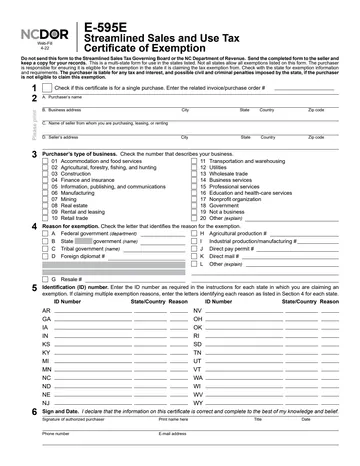
Form E-595E is North Carolina's resale and exemption certificate. The Department of Revenue's form page says it “is to be used for purchases for resale or other exempt purchases.” It is the Streamlined Sales and Use Tax Certificate of Exemption in North Carolina's own print, so one completed form can cover purchases in the other member states listed in Section 5. The rules behind it are on the North Carolina resale certificate page; this page walks the form.
- Who completes it. The purchaser. The purchaser completes Form E-595E, a multi-state form, sends it to the seller and keeps a copy.
- Where it goes. “Do not send this form to the Streamlined Sales Tax Governing Board or the NC Department of Revenue. Send the completed form to the seller and keep a copy for your records.”
- The form. Form E-595E, revision Web-Fill 4-22. The PDF has three pages: a sheet on using the fill-in PDF (marked "Do Not Include This Page"), the certificate, and its instructions.
- When. At the sale or within 90 days; within 120 days after a Department request for substantiation (G.S. 105-164.28).
- How long. No renewal required while no more than 12 months pass between sales (G.S. 105-164.28(e)).
North Carolina's version of the SST certificate
The E-595E carries the multistate form's text and layout with North Carolina's header and citations. Three things differ from the Governing Board's own SST Certificate of Exemption:
- Fewer reasons. The Governing Board's form lists “E Charitable organization”, “F Religious organization” and “M Educational Organization”. North Carolina's Section 4 lists A to D and G to L, with shaded bars where E and F would be.
- North Carolina's blanket rule. The Section 1 instruction adds the state's own 12-month recurring relationship sentence, which matches G.S. 105-164.28(e).
- The statute is cited. The seller's instructions point to “N.C. Gen. Stat. § 105-164.28” for records and the 90-day window.
Every section is required: “Sections 1-6 are required information.” The Department's exemptions page lists the same data elements and warns: “If any of the required data elements are not provided to the seller, the Certificate of Exemption is incomplete and invalid.”
Tap a box once for its note, again to jump to the line. Zoom in to read the small print.
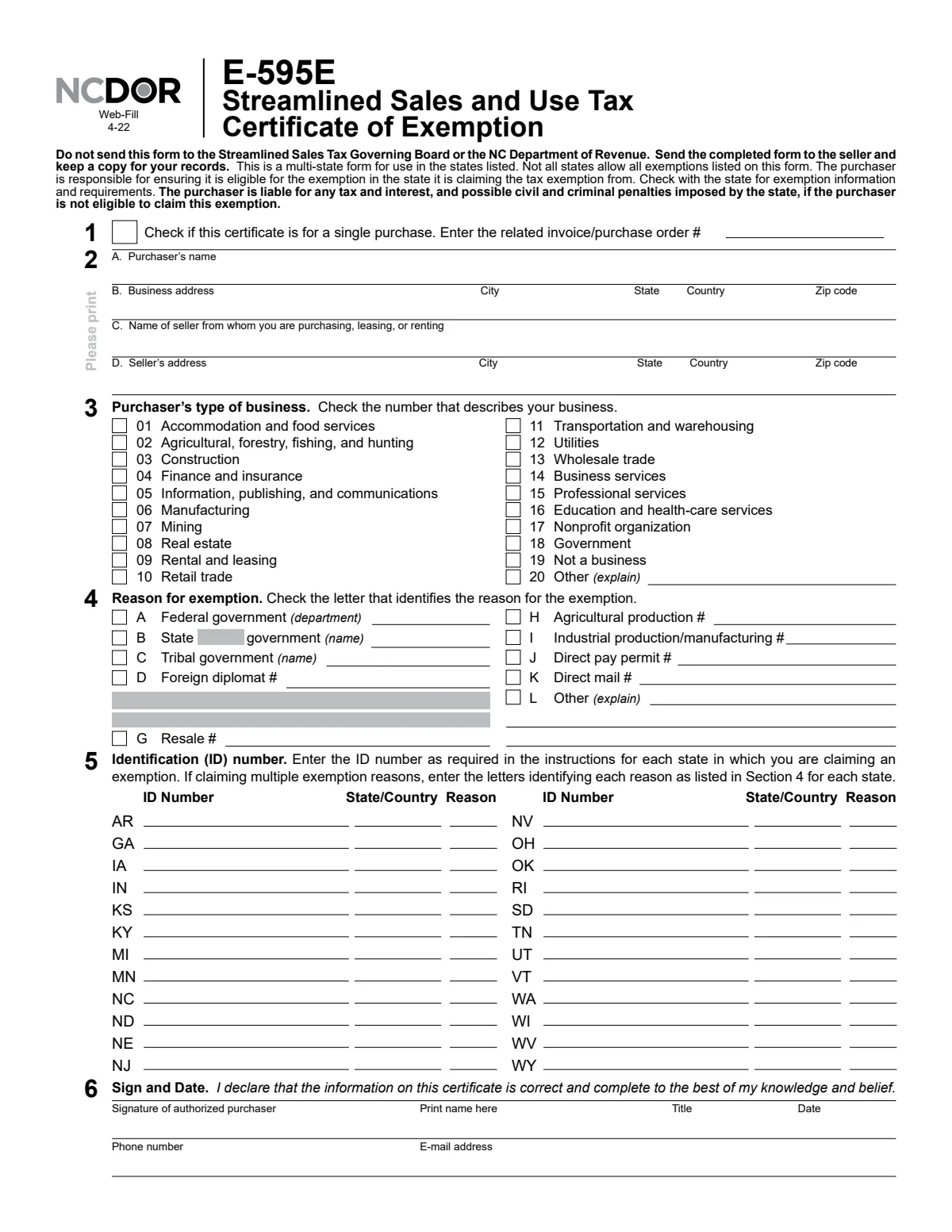
Sections 1 and 2: purchase type and parties
Section 1 decides whether the form is a single-purchase or a blanket certificate. Section 2 names both parties; the buyer's name and address are required data elements, and the seller's lines tie the certificate to one seller.
| Line | As printed | What goes there |
|---|---|---|
| 1 | 1 Check if this certificate is for a single purchase. Enter the related invoice/purchase order # | The form's instructions: “Check the box for a single purchase and enter the invoice/purchase order number.” “If the box is not checked, this certificate is considered a blanket certificate and remains effective until cancelled by the purchaser if purchases are no more than 12 months apart, unless a longer period is allowed by a state.” “In North Carolina, a recurring business relationship exists when a period of no more than 12 months elapses between sales transactions.” |
| 2A | 2 A. Purchaser’s name | The buyer's name, a required data element on North Carolina's list: “The purchaser's name.” |
| 2B | B. Business address, City, State, Country, Zip code | “Enter the purchaser’s and seller’s name, street address, city, state, country, and zip code.” The purchaser's address is a required data element (G.S. 105-164.28(a)(1)). |
| 2C | C. Name of seller from whom you are purchasing, leasing, or renting | The seller receiving the certificate. A blanket certificate is given to each seller separately. |
| 2D | D. Seller’s address, City, State, Country, Zip code | The seller's full address, as in Section 2's instruction. |
Sections 3 and 4: business and reason
Section 3 is the buyer's type of business, Section 4 the reason. Together they are how a seller judges whether the claim makes sense: a retailer of hardware claiming G for hardware fits; the same retailer claiming G for office furniture it will use does not.
| Line | As printed | What goes there |
|---|---|---|
| 3 | 3 Purchaser’s type of business. Check the number that describes your business. (01 to 20) | “Check the number that best describes the purchaser’s business or organization. If none of the categories apply, check 20 and provide a brief description.” The type of business is a required data element, and it matters later: on an audit request, a certificate is in good faith only if the exemption “is reasonable for the purchaser's type of business.” (G.S. 105-164.28(b)(1)c.) A reseller usually checks 10 Retail trade or 13 Wholesale trade. |
| 4 | 4 Reason for exemption. Check the letter that identifies the reason for the exemption. (A to D, H to L) | “Check the letter that identifies the reason for the exemption. If the exemption you are claiming is not listed, check ‘L Other’ and provide a clear and concise explanation of the exemption claimed.” “Not all states allow all exemptions listed on this form.” North Carolina's version prints reasons A to D and G to L; two shaded bars stand where E and F would be. |
| 4-G | G Resale # | The reason for a purchase for resale. The ID number that goes with it depends on where the buyer is registered; the four cases are in the table under Section 5. For a North Carolina purchase, the number is “The purchaser's sales and use tax certificate of registration number or other North Carolina issued exemption number.” |
Section 5: the ID number
Section 5 is where most errors happen. The instructions give four cases for a resale (reason G) claim, including drop shipments:
| If the buyer is ... | Enter as the ID number (reason G) |
|---|---|
| 1. Required to be registered in the state where it claims the exemption | “Provide your sales tax ID number issued by that state.” |
| 2. Not registered in that state | “Provide your sales tax ID number issued by any state.” |
| 3. Not required to register anywhere and holding no sales tax number | Its FEIN; if none, another state-issued business ID number; if none, its state driver's license number (instructions, case 3). |
| 4. A foreign buyer with none of the above | A tax ID from its own country (such as a VAT number), accepted by AR, IN, KS, KY, ND, NJ, OK, RI, SD, TN, UT, WA and WY; “All other states require an ID number as listed in 1, 2 or 3.” |
After case 4: “You are not required to list an ID number for the following states: NE, OH, SD, WI.” North Carolina requires a number; for a North Carolina claim the Department says “A sales and use tax certificate of registration number should be used by a retailer, a wholesale merchant, or facilitator (Ex. Purchasing an item for resale).”
| Line | As printed | What goes there |
|---|---|---|
| 5 | 5 Identification (ID) number. Enter the ID number as required in the instructions for each state ... | “Identify the state or if a foreign ID, the country the ID number is from. If multiple exemption reasons are being claimed enter the letters identifying the reasons for exemption as listed in Section 4 for each state.” |
| 5-left | AR, GA, IA, IN, KS, KY, MI, MN, NC, ND, NE, NJ | Fill in only the rows for states where the buyer claims the exemption. On the NC row, a reseller enters its sales and use tax registration number, G as the reason, and the state that issued the number, which “may be issued by North Carolina or another state.” The MI row has its own rule: “If claiming exemption in MI and registration is not required in the state, enter ‘Not Required’.” (see Michigan Form 3372). |
| 5-right | NV, OH, OK, RI, SD, TN, UT, VT, WA, WI, WV, WY | Same three columns. Ohio has its own line in the instructions: “If claiming exemption in OH and registration is not required in the state, enter any tax ID number issued by OH.” Nebraska, Ohio, South Dakota and Wisconsin accept “‘Not Required’” when the buyer has none of the numbers in cases 1 to 4. |
Section 6: signature
| Line | As printed | What goes there |
|---|---|---|
| 6 | 6 Sign and Date. Signature of authorized purchaser, Print name here, Title, Date | “Sections 1-6 are required information. A signature is not required if in electronic form.” The statute agrees: for a remote sale, an electronic certificate “is not required to be signed by the purchaser.” (G.S. 105-164.28(a)(3)). A paper or faxed certificate must be signed (G.S. 105-164.28(a)(1)). |
| 6-contact | Phone number, E-mail address | The instructions ask the signer to give “your title, phone number, and e-mail address where you can be reached if the Department has questions about your certificate of exemption.” |
The seller's side
E-595E instructions; G.S. 105-164.28(a), (b). The amber step: after 90 days, relief comes only through the 120-day substantiation route.
- No duty to verify. “The seller is not required to verify the purchaser’s ID number or determine the purchaser’s registration requirements.” The statute says the same (G.S. 105-164.28(b)). The form adds that Georgia requires the seller to verify; Georgia's own pages say “Sellers may verify a sales tax number”, and this site follows Georgia's text (see the Georgia page).
- Relief from liability. The seller owes nothing if the buyer claimed wrongly, provided “The fully completed exemption certificate or required data elements are provided to the seller at the time of sale or within 90 days subsequent to the date of sale”, and the seller did not fraudulently fail to collect or solicit unlawful claims.
- After 90 days. If the Department finds a certificate incomplete, the seller has a second chance: “If a seller does one of the following within 120 days after a request for substantiation by the Secretary, the seller is not liable for the tax otherwise applicable:” a fully completed certificate given in good faith, or other information showing the sale was not taxable.
- Records. “These certificates may be provided in paper or electronic format.” Paper or electronic; without a paper certificate, keep the data elements electronically (E-595E); missing records make the retailer liable (G.S. 105-164.22(b)); number of years not stated.
- Lookup. The Department's Exemption Certificate Number Registry covers exemption certificate numbers and direct pay permits, not registration numbers. Searches exemption certificate numbers and direct pay permits; a seller need not verify a buyer's registration number (G.S. 105-164.28(b)).
Drop shipments
The instructions treat a drop shipper the same way as any seller: “The drop shipper may accept an ID number to claim the resale exemption as provided above in the Purchaser’s Instructions. The ID number may include an ID number issued by another state.” The statute protects a third-party vendor that takes “a certificate of exemption provided by its customer or any other acceptable information evidencing qualification for a resale exemption, regardless of whether the customer is registered to collect and remit sales and use tax in the State.” (G.S. 105-164.28(a)(4)). See drop shipments by state.
Common mistakes
- Leaving Section 1 blank by accident. An unchecked box makes the form a blanket certificate. Check it for a one-time purchase and give the invoice number.
- Reason G with a number in the wrong row. The ID number belongs on the row for the state where the exemption is claimed, with that state's reason letter.
- No signature on a paper copy. Paper and fax need a signature; only an electronic certificate may go unsigned (G.S. 105-164.28(a)).
- Using it for property the buyer uses. “A purchaser who does not resell an item purchased under a certificate of exemption is liable for any tax subsequently determined to be due on the sale.” Misuse costs more: $250 penalty for each seller from which the purchaser misused a certificate (G.S. 105-236); issuing one to avoid tax may be a Class H felony.
- Sending it to the Department. The certificate goes to the seller only.
How it connects
- North Carolina's rules, misuse penalty, records and registration: North Carolina resale certificate.
- The multistate form it is based on, with each member state's rules: SST Certificate of Exemption. The other multistate form: MTC uniform certificate. MTC note: Not valid as an exemption certificate if signed by a person such as a contractor who intends to use the property; use is subject to G.S. 105-164.28.
- Buying from a state where the buyer is not registered: out-of-state resale certificates. Keeping certificates: resale certificate records.
- Other form pages: Michigan Form 3372, New York ST-120, California CDTFA-230.
Common questions
Can a buyer registered only in another state use the E-595E in North Carolina?
Yes. For a resale claim the registration number may come from North Carolina or another state: Yes: the registration number may be issued by North Carolina or another state.
Does a blanket E-595E expire?
Not while the relationship recurs. It stays in effect until the buyer cancels it if no more than 12 months pass between sales, and the Department may not require the seller to renew it in a recurring relationship (G.S. 105-164.28(e)).
Does the seller have to check the buyer's number?
No. G.S. 105-164.28(b) says a seller is not required to verify that a certificate of registration number is correct, and the form's seller instructions say the same.
Is an unsigned E-595E valid?
Only in electronic form. A paper certificate, including one received by fax, must be signed (G.S. 105-164.28(a)(1)).
What if the buyer gives the certificate after 90 days?
The 90-day relief does not apply, but the seller can still avoid the tax by getting a fully completed certificate given in good faith, or other proof, within 120 days after a Department request for substantiation (G.S. 105-164.28(b)).
Sources
- North Carolina Department of Revenue, Form E-595E, Streamlined Sales and Use Tax Certificate of Exemption, Web-Fill 4-22, with its instructions; the E-595E form page
- N.C. Gen. Stat. 105-164.28, Certificate of exemption
- North Carolina Department of Revenue, Sales and use tax exemptions (certificates of exemption, data elements, misuse)
- Georgia Department of Revenue, nontaxable sales (seller verification)