- Who completes it
- The Georgia purchaser
- Given to
- Each supplier, once; the supplier keeps it on file
- Form revision
- Rev. 07/11/22
- Pages
- 1 page
- Seller keeps it
- Three years
Form ST-5 (Rev. 07/11/22); Policy Bulletin SUT 2010-10-13; Rule 560-12-1-.23.
At a glance
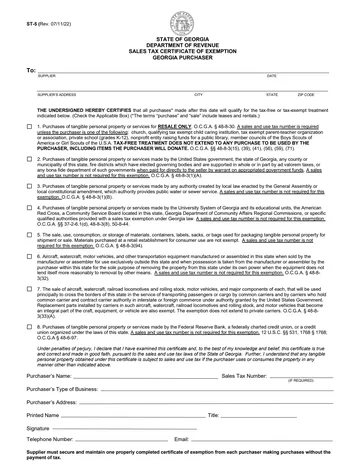
Form ST-5 is Georgia's Sales Tax Certificate of Exemption for Georgia purchasers. It is one page with eight check boxes; box 1 is the resale certificate, and boxes 2 to 8 are exemptions for governments, authorities, carriers and credit unions. The purchaser completes it and gives it to the supplier. The revision printed on the form is Rev. 07/11/22, and the Department of Revenue posts it on its ST-5 page as a fillable PDF: Form ST-5.
- Who completes it. The rule: “This Certificate shall be used by registered Georgia dealers and/or Georgia purchasers coming under the provisions of this Act, and shall indicate the reason for the exemption.” (Rule 560-12-1-.08(2)(b)).
- Where it goes. To the supplier, who keeps it. The DOR says a Georgia business buys for resale without paying sales tax by giving the supplier a properly completed ST-5. The supplier keeps it on file for the Commissioner's inspection (Rule 560-12-1-.08(2)).
- Blanket by design. It covers all qualifying purchases after its date, one certificate per purchaser.
- No expiry. “Most certificates of exemption and letters of authorization do not expire”, except the agricultural GATE certificate (DOR, Nontaxable Sales).
Georgia's rules on the certificate (good faith, the 90 and 120 day windows, records, misuse, drop shipments, the other Georgia certificates) are on our Georgia resale certificate page. This page walks the form.
Tap a box once for its note, again to jump to the line. Zoom in to read the small print.
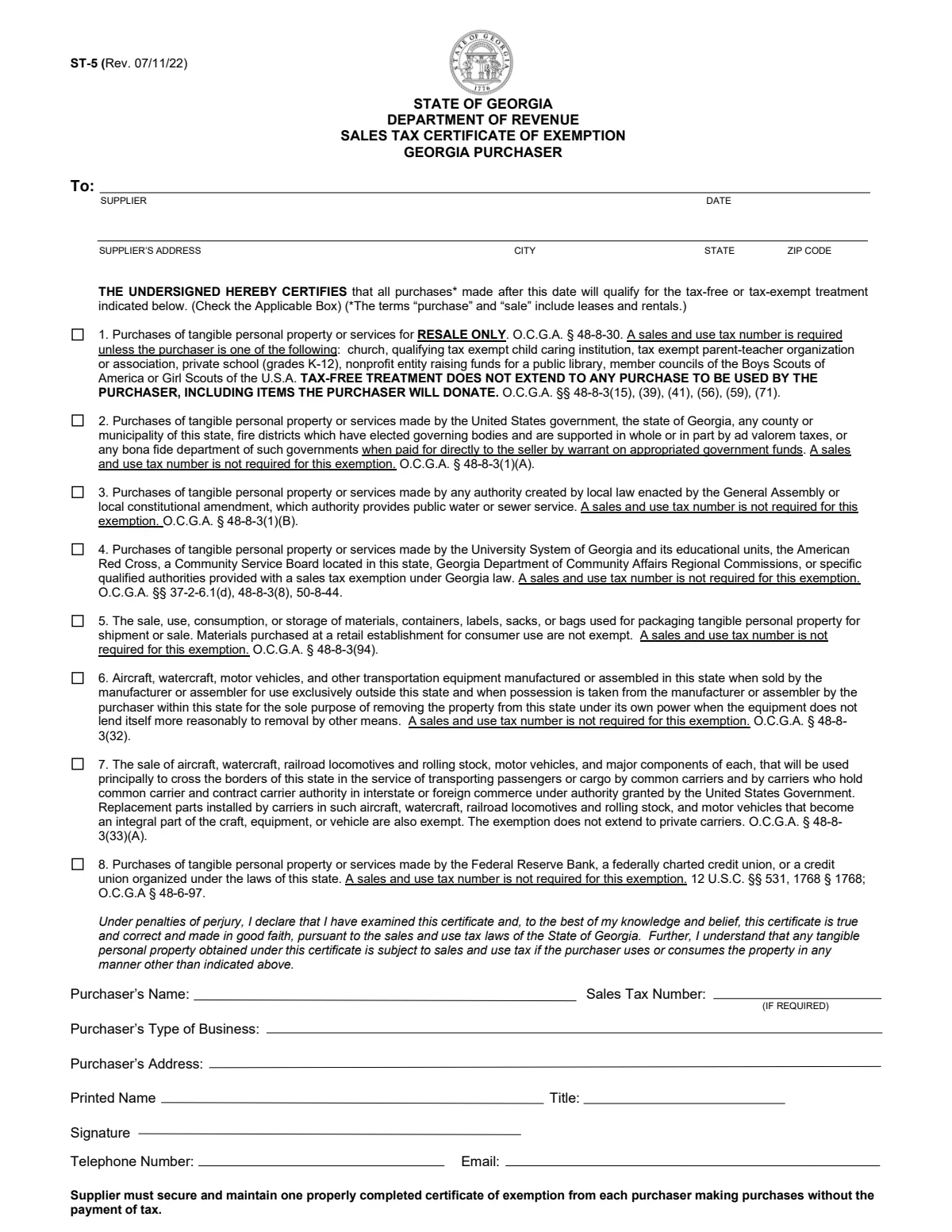
Supplier, date and the certification
| Line | Label | What goes there |
|---|---|---|
| Supplier | To: SUPPLIER | The seller's name. ST-5 is addressed to one supplier, and the footer asks the supplier to hold one certificate from each purchaser. |
| Date | DATE | The start date. The certification covers purchases made after this date, so the form works as a blanket certificate from the start. Our state page carries the term as: Until revoked (GATE agricultural certificates expire yearly). |
| Supplier-address | SUPPLIER'S ADDRESS, CITY, STATE, ZIP CODE | The supplier's address. |
| Certifies | THE UNDERSIGNED HEREBY CERTIFIES ... (Check the Applicable Box) | “THE UNDERSIGNED HEREBY CERTIFIES that all purchases* made after this date will qualify for the tax-free or tax-exempt treatment indicated below.” The asterisk adds that purchase and sale include leases and rentals. Check the box that applies; Rule 560-12-1-.08 says ST-5 shall indicate the reason for the exemption. |
Boxes 1 to 8: the reason for the exemption
Check the box that applies. Each box cites its Georgia statute and says whether a sales and use tax number is required. Only box 1 requires one, and box 1 is the only resale box.
Form ST-5 (Rev. 07/11/22); Rule 560-12-1-.08; DOR drop shipment policy (Dec. 7, 1995).
| Line | Label | What goes there |
|---|---|---|
| 1 | 1. Purchases of tangible personal property or services for RESALE ONLY. O.C.G.A. § 48-8-30. | The resale box, the one most buyers check. A sales and use tax number is required unless the purchaser is a church, a qualifying tax exempt child caring institution, a tax exempt parent-teacher organization, a K-12 private school, a nonprofit raising funds for a public library, or a Boy Scouts or Girl Scouts member council. “TAX-FREE TREATMENT DOES NOT EXTEND TO ANY PURCHASE TO BE USED BY THE PURCHASER, INCLUDING ITEMS THE PURCHASER WILL DONATE.” A Georgia business without a sales tax number registers first, through the Georgia Tax Center. |
| 2 | 2. Purchases ... made by the United States government, the state of Georgia, any county or municipality ... O.C.G.A. § 48-8-3(1)(A). | For government purchases paid directly to the seller by warrant on appropriated government funds. A government employee paying personally does not fit. Federal purchases are covered on our federal purchases page. |
| 3 | 3. Purchases ... made by any authority ... which provides public water or sewer service. O.C.G.A. § 48-8-3(1)(B). | Public water and sewer authorities created by local law. No number required. |
| 4 | 4. Purchases ... made by the University System of Georgia ... O.C.G.A. §§ 37-2-6.1(d), 48-8-3(8), 50-8-44. | The University System of Georgia and its units, the American Red Cross, Community Service Boards, Regional Commissions, and authorities given a sales tax exemption by Georgia law. No number required. |
| 5 | 5. The sale, use, consumption, or storage of materials, containers, labels, sacks, or bags used for packaging ... O.C.G.A. § 48-8-3(94). | Packaging that goes out with the product. The form: materials bought at a retail establishment for consumer use are not exempt. |
| 6 | 6. Aircraft, watercraft, motor vehicles, and other transportation equipment manufactured or assembled in this state ... O.C.G.A. § 48-8-3(32). | Only when sold by the Georgia manufacturer or assembler for use exclusively outside Georgia, with possession taken in Georgia solely to remove it under its own power. |
| 7 | 7. The sale of aircraft, watercraft, railroad locomotives and rolling stock, motor vehicles ... O.C.G.A. § 48-8-3(33)(A). | Equipment used principally to cross state lines carrying passengers or cargo for common and contract carriers with federal authority, plus replacement parts that become an integral part. The exemption does not extend to private carriers. |
| 8 | 8. Purchases ... made by the Federal Reserve Bank, a federally charted credit union, or a credit union organized under the laws of this state. | Cites 12 U.S.C. 531 and 1768 and O.C.G.A. 48-6-97. No number required. |
The purchaser's block
The bottom of the form is the purchaser's declaration and details. The sales tax number sits next to the name, marked if required.
| Line | Label | What goes there |
|---|---|---|
| Perjury | Under penalties of perjury, I declare ... | “Under penalties of perjury, I declare that I have examined this certificate”, that it is true, correct and made in good faith, and that property used or consumed in any other manner is subject to sales and use tax. |
| Name | Purchaser's Name: | The purchaser's legal name. |
| Number | Sales Tax Number: (IF REQUIRED) | The purchaser's Georgia sales tax number. For box 1, Georgia's resale test is that the purchaser “Has a valid sales tax registration number at the time of purchase and has listed his or her sales tax number on the certificate” (O.C.G.A. 48-8-38). For boxes 2 to 8 the form says no number is required. An out-of-state dealer buying for resale in another state uses Form ST-4 instead (see the mistakes below). |
| Business | Purchaser's Type of Business: | What the purchaser does. A certificate taken in good faith is one “Claiming an exemption that is reasonable for the purchaser's type of business.” |
| Address | Purchaser's Address: | The purchaser's address. |
| Printed-name | Printed Name | The signer's printed name. |
| Title | Title: | The signer's title. |
| Signature | Signature | The signature under the perjury declaration. The DOR's good faith list asks for the signature of the taxpayer when required. |
| Telephone | Telephone Number: | The purchaser's phone. |
| Email: | The purchaser's email. | |
| Supplier-keeps | Supplier must secure and maintain one properly completed certificate ... | “Supplier must secure and maintain one properly completed certificate of exemption from each purchaser making purchases without the payment of tax.” One per purchaser, not one per sale. |
What the supplier does with it
Georgia DOR, Nontaxable Sales; Policy Bulletin SUT 2010-10-13; Rule 560-12-1-.23.
- Take it in good faith. The DOR's list: the certificate is fully completed, in a form appropriate for the exemption, claims an exemption available by statute on the date of the sale, could apply to the item, and is reasonable for the purchaser's type of business. On a resale, the purchaser is in the business of selling, lists a valid sales tax number, and the seller has no reason to believe it will not resell. Our state page: A seller that takes a fully completed certificate in good faith is relieved of the tax (O.C.G.A. 48-8-38(a)).
- On time. The seller is relieved if it has a fully completed certificate within ninety days after the sale; if not, “the Department will provide the seller with 120 days subsequent to a request for substantiation” to get one in good faith or other proof (Policy Bulletin SUT 2010-10-13). Our state page: Within 90 days after the sale; 120 days after a request for substantiation.
- Keep it. Keep exemption and resale certificates three years, and longer while an appeal is pending (Rule 560-12-1-.23). The rule's list of dealer records includes exemption and resale certificates (Rule 560-12-1-.23).
- Misuse. “Misuse of a Certificate of Exemption or a Letter of Authorization shall be sufficient cause for the Commissioner to revoke the Certificate of the seller, purchaser or both.” (Rule 560-12-1-.08).
Verifying the number: may or must
The Georgia DOR says: “Sellers may verify a sales tax number by using the Sales Tax ID Verification Tool.” The Georgia Tax Center's Sales Tax ID Verification Tool takes one number or an uploaded list, and the DOR suggests printing the results for your records. “This tool only verifies Georgia Sales Tax Numbers.” It does not check federal, out-of-state or Social Security numbers.
The Streamlined Sales Tax site's exemption page says otherwise, in a note: “(Note: GA requires the seller verify the purchaser's ID number.)” Georgia's own statement governs on this site until a Georgia rule says otherwise, so verification is good practice in Georgia, not a stated requirement. Checking the number is the cleanest proof that the purchaser had a valid number at the time of purchase, which is part of Georgia's resale test. See how to verify a resale certificate in every state.
Mistakes the form invites
- An out-of-state buyer using ST-5. ST-5 is for Georgia purchasers. The rule for the other case: “This Certificate shall be used by out-of-state dealers purchasing tangible personal property in Georgia for resale in another state.” (Rule 560-12-1-.08(2)(a), Form ST-4).
- An out-of-state buyer with a drop shipment into Georgia. Neither ST-5 nor ST-4 fits. The DOR's 1995 drop shipment policy says “Currently, Georgia does not have a certificate of exemption form that can be used by purchasers for these types of transactions.” It accepts the MTC uniform certificate or the purchaser's home state certificate with its resale number, unless one of six conditions applies (for example, the purchaser has nexus with Georgia). The MTC's Georgia note 9 says the same for a purchaser with no Georgia nexus.
- Box 1 for supplies or gifts. The form says tax-free treatment does not extend to purchases the purchaser uses, including items it will donate.
- Leaving the sales tax number blank on box 1. Unless the purchaser is one of the listed nonprofits, box 1 requires it.
- One certificate per sale. Not needed: one certificate covers every later qualifying purchase from that supplier.
How it connects
The Georgia resale certificate page has the state's rules in full and the other Georgia certificates: ST-4 for out-of-state purchasers, ST-5M for manufacturers, ST-6 for out-of-state delivery in the seller's vehicle, and the nonprofit applications. Georgia is a full member of the Streamlined Sales Tax Agreement, so the SST Certificate of Exemption also works there; our state page shows it as: Accepted (full SST member since July 1, 2011). See also the MTC uniform certificate and drop shipments by state. Other forms on the form itself: Illinois CRT-61, New Jersey ST-3 and Texas 01-339.
Common questions
Does Georgia Form ST-5 expire?
No. The DOR says most certificates of exemption do not expire, the agricultural GATE certificate being the exception. An ST-5 covers all qualifying purchases made after its date until it is revoked or replaced.
Do I need a separate ST-5 for every purchase?
No. The supplier keeps one properly completed certificate from each purchaser that buys without paying tax, and it covers all later qualifying purchases.
Can an out-of-state business use Georgia Form ST-5?
Not for resale outside Georgia: out-of-state dealers buying in Georgia for resale in another state use Form ST-4. For a drop shipment to a Georgia customer by a buyer with no Georgia nexus, the DOR accepts the MTC form or the buyer's home state certificate with its resale number.
Does a Georgia seller have to verify the buyer's sales tax number?
The Georgia DOR says sellers may verify a number with the Sales Tax ID Verification Tool. A note on the Streamlined Sales Tax site says Georgia requires it. Georgia's own statement governs here, and checking is good practice either way.
Is Georgia Form ST-5 the same as New Jersey Form ST-5?
No. New Jersey's ST-5 is an Exempt Organization Certificate that the New Jersey Division of Taxation issues to qualifying nonprofits. Georgia's ST-5 is the certificate a Georgia purchaser fills out for its supplier.
Can a nonprofit use ST-5 box 1 without a sales tax number?
Only the organizations the form lists: churches, qualifying tax exempt child caring institutions, tax exempt parent-teacher organizations, K-12 private schools, nonprofits raising funds for a public library, and Boy Scouts and Girl Scouts member councils, and only for purchases for resale.
Sources
- Form ST-5, Sales Tax Certificate of Exemption, Rev. 07/11/22
- Georgia DOR, ST-5 Certificate of Exemption page
- Georgia DOR, Nontaxable Sales
- Georgia DOR, Sales Tax ID Verification Tool
- Ga. Comp. R. & Regs. 560-12-1 (Rules 560-12-1-.08, Certificate of Exemption, and 560-12-1-.23, Preservation of Records)
- Policy Bulletin SUT 2010-10-13, Conformity with certain provisions of the Streamlined Sales Tax Agreement
- Policy Statement for Third-Party Drop Shipment Transactions (effective Dec. 7, 1995)
- Streamlined Sales Tax Governing Board, exemptions page
- MTC Uniform Sales and Use Tax Resale Certificate (Rev. Oct. 14, 2022), Georgia note 9