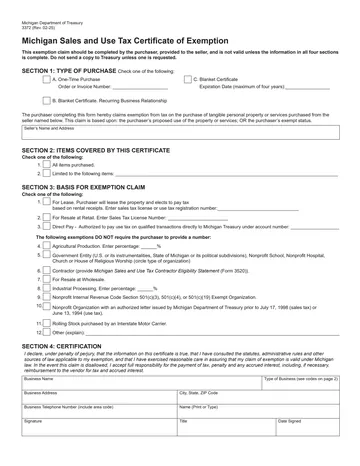
- Who completes it
- The purchaser
- When
- Within 120 days after the sale
- Kept by
- The seller, at least 4 years; not sent to Treasury unless asked
- Form revision
- 3372 (Rev. 02-25)
- Pages
- 2 (certificate, instructions)
At a glance
Form 3372 is Michigan's Sales and Use Tax Certificate of Exemption. It covers resale and the other common exemptions on one form. “This exemption claim should be completed by the purchaser, provided to the seller, and is not valid unless the information in all four sections is complete. Do not send a copy to Treasury unless one is requested.” Michigan's rules for every claim are on the Michigan resale certificate page; this page walks the form.
- Who completes it. The purchaser. The purchaser gives Form 3372, the MTC or SST certificate, a qualifying purchase order or a signed letter; no signature needed unless on paper (RAB 2024-11).
- The form. Form 3372, printed revision 3372 (Rev. 02-25). Page 1 is the certificate; page 2 holds the instructions and the business type codes.
- When. Within 120 days after the sale; a later cure is allowed up to 120 days after a Treasury request or other set dates (MCL 205.62).
- How long. Blanket: 4 years unless a shorter period is agreed; no renewal needed while sales occur at least every 12 months (RAB 2024-11).
- No exemption numbers. “Michigan does not issue ‘tax exempt numbers’ and a seller is not permitted to rely on a number in lieu of a valid exemption claim.”
Form 3372 and the other accepted formats
Form 3372 is one of several formats Treasury accepts. RAB 2024-11 lists them: Form 3372, a format in a current administrative rule, “The Uniform Sales and Use Tax Certificate approved by the Multistate Tax Commission.”, a qualifying purchase order, “The Streamlined Sales and Use Tax Agreement Certificate of Exemption.”, or “The required statutory information in another format, such as in a signed letter on the purchaser's letterhead.” Whatever the format, the claim needs the buyer's name and address, the reason, and anything the specific exemption requires. For resale at retail, that includes the buyer's Michigan sales tax license number if it has one.
A buyer using the Streamlined form or North Carolina's E-595E for Michigan has a special instruction on that form: if it is not required to register in Michigan, it writes "Not Required" on the MI row (see the E-595E page).
Tap a box once for its note, again to jump to the line. Zoom in to read the small print.
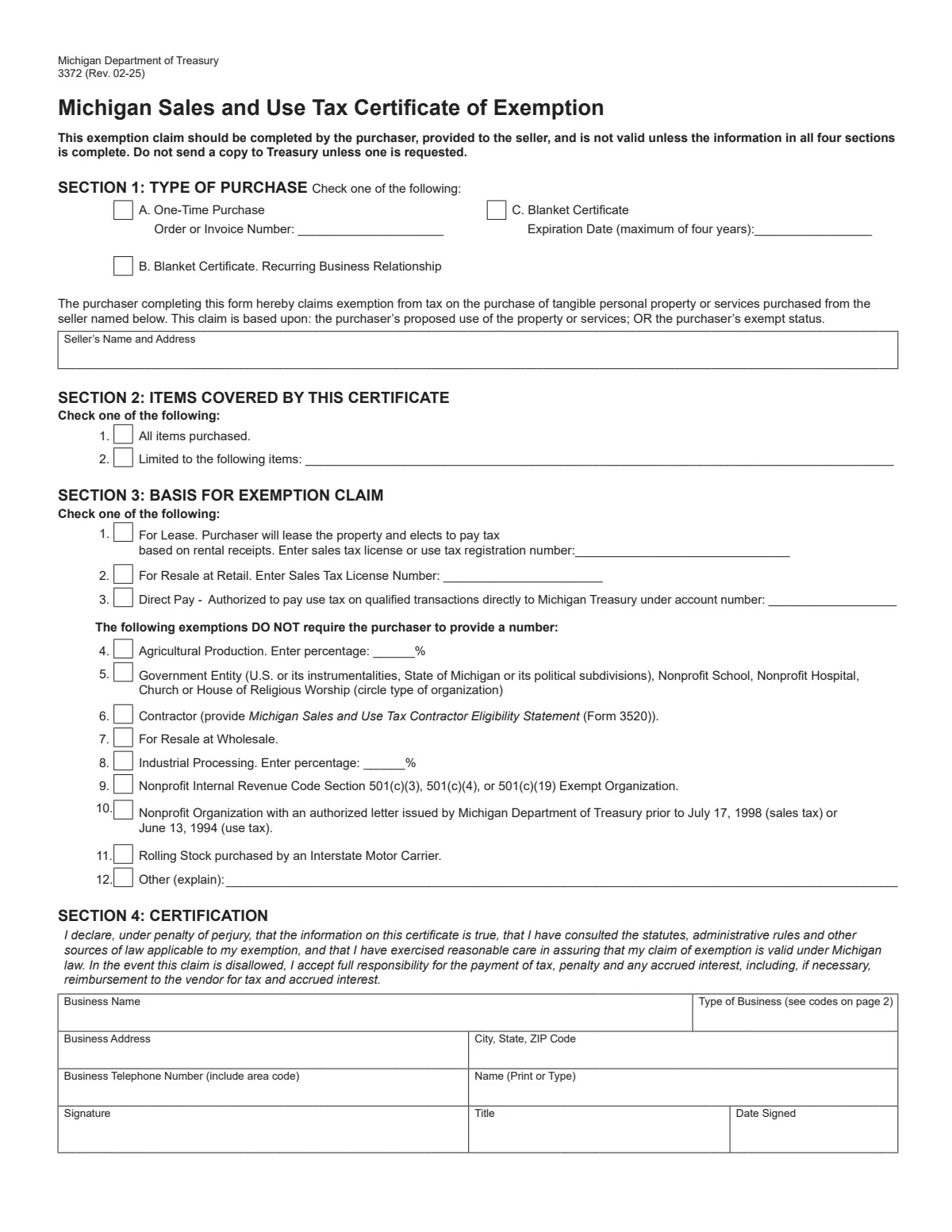
Section 1: type of purchase
Check one of three boxes. A and C have a blank to fill in; B does not. The choice sets how long the claim lasts.
Form 3372 instructions; RAB 2024-11, parts 3, 6 and 7; MCL 205.62(6).
| Line | As printed | What goes there |
|---|---|---|
| 1A | A. One-Time Purchase, Order or Invoice Number: | “Choose ‘One-Time Purchase’ and include the invoice number this certificate covers.” |
| 1B | B. Blanket Certificate. Recurring Business Relationship | “Choose ‘Blanket Certificate’ if there is a ‘recurring business relationship.’ This exists when a period of not more than 12 months elapses between sales transactions between the seller and purchaser.” “Parties do not need to renew this blanket exemption claim as long as the recurring business relationship exists.” |
| 1C | C. Blanket Certificate, Expiration Date (maximum of four years): | “Choose ‘Blanket Certificate’ and enter the expiration date (maximum four years) when there may be a period of more than 12 months between sales transactions.” RAB 2024-11: “A Blanket Certificate of Exemption remains in effect for a four-year period unless the seller and the purchaser indicate on the Blanket Certificate of Exemption or otherwise in writing that a period of less than four years will apply.” |
| seller | Seller’s Name and Address | The seller receiving the claim. The sentence above the box says the claim covers goods or services “purchased from the seller named below.” |
Section 2: items covered
| Line | As printed | What goes there |
|---|---|---|
| 2-1 | 1. All items purchased. | “Place a check in the box for ‘All items purchased’ or choose ‘Limited to’ and list the items that are covered by the exemption claim.” A reseller that also buys supplies it will use should not check this box; it would claim resale on items it consumes. |
| 2-2 | 2. Limited to the following items: | The safer choice for most resellers: list the product lines bought for resale, so purchases of supplies stay taxable. |
Section 3: basis for the claim
Check one box. Resale has two: 2 for resale at retail (with the license number) and 7 for resale at wholesale. Items 1 to 3 ask for a number; items 4 to 12 do not. The instructions: “The exemptions listed are the most common.”
| Line | As printed | What goes there |
|---|---|---|
| 3-1 | 1. For Lease. Purchaser will lease the property and elects to pay tax based on rental receipts. Enter sales tax license or use tax registration number: | For a lessor paying use tax on rental receipts instead of tax on the purchase price. RAB 2024-11: such a lessor “must provide the seller with the lessor's sales tax license number or use tax registration number.” |
| 3-2 | 2. For Resale at Retail. Enter Sales Tax License Number: | The usual box for a retailer buying goods to resell. RAB 2024-11 sets the rule: “the seller must obtain the sales tax license number of the purchaser if the purchaser has a sales tax license”. A buyer with no Michigan license may still claim resale; a buyer without a Michigan license may claim resale; the license number is required only if the buyer has one (RAB 2024-11). |
| 3-3 | 3. Direct Pay - Authorized to pay use tax on qualified transactions directly to Michigan Treasury under account number: | Only for a buyer holding a direct pay authorization. Treasury's FAQ says such a customer should state it is “Authorized to pay sales or use taxes on purchases of tangible personal property directly to the State of Michigan” and give its account number. |
| 3-4 | 4. Agricultural Production. Enter percentage: ______% | Not a resale claim. The heading above it applies to items 4 to 12: “The following exemptions DO NOT require the purchaser to provide a number:” |
| 3-5 | 5. Government Entity (U.S. or its instrumentalities, State of Michigan or its political subdivisions), Nonprofit School, Nonprofit Hospital, Church or House of Religious Worship (circle type of organization) | An entity-based exemption, not resale. Circle the type that applies. |
| 3-6 | 6. Contractor (provide Michigan Sales and Use Tax Contractor Eligibility Statement (Form 3520)). | Not resale. The contractor attaches Form 3520. RAB 2024-11 notes contractors use Form 5555, not Form 3372, for a transformational brownfield plan. |
| 3-7 | 7. For Resale at Wholesale. | Treasury's FAQ: “wholesalers may purchase tangible personal property exempt from sales and use tax if purchasing for ‘resale at wholesale.’” The form puts this box under the heading for exemptions that do not require a number. |
| 3-8 | 8. Industrial Processing. Enter percentage: ______% | A use-based exemption, not resale. |
| 3-9 | 9. Nonprofit Internal Revenue Code Section 501(c)(3), 501(c)(4), or 501(c)(19) Exempt Organization. | Not resale. Treasury's FAQ: these organizations “must provide proof that they are exempt under these codes by the Internal Revenue Service.” See 501(c)(3) sales tax exemption. |
| 3-10 | 10. Nonprofit Organization with an authorized letter issued by Michigan Department of Treasury prior to July 17, 1998 (sales tax) or June 13, 1994 (use tax). | Not resale. Only organizations holding such a letter use this box. |
| 3-11 | 11. Rolling Stock purchased by an Interstate Motor Carrier. | Not resale. Treasury's rolling stock bulletin is RAB 2023-12. |
| 3-12 | 12. Other (explain): | “If the exemption you are claiming is not listed, check ‘Other’ and enter the qualifying exemption.” |
Section 4: certification
The buyer's identity and signature. Every box is required, except that the signature is needed only on paper.
| Box | As printed | What goes there |
|---|---|---|
| 4 | SECTION 4: CERTIFICATION. I declare, under penalty of perjury ... | Nothing to enter. The buyer accepts that “In the event this claim is disallowed, I accept full responsibility for the payment of tax, penalty and any accrued interest, including, if necessary, reimbursement to the vendor for tax and accrued interest.” |
| 4-name | Business Name | “Purchaser must complete Section 4.” The buyer's name is part of the identifying information the statute requires (RAB 2024-11, part 1). |
| 4-type | Type of Business (see codes on page 2) | “For Type of Business, enter the number from the following list that best describes the purchaser’s business.” Codes include 07 Retail and 11 Wholesale; “16 Other (enter code and write in business type)”. |
| 4-address | Business Address | Name and address are the identifying information every claim needs: “The identifying information of the purchaser, including the purchaser's name and address.” |
| 4-city | City, State, ZIP Code | The rest of the buyer's address. An out-of-state buyer gives its own state. |
| 4-phone | Business Telephone Number (include area code) | “All fields must be completed; however, if provided to the purchaser in electronic format, a signature is not required.” |
| 4-print | Name (Print or Type) | The signer's name, so the seller knows who made the claim. |
| 4-sign | Signature | “A signature is only required if a paper form is used; in that case, the purchaser should sign and provide their title (for example, Purchasing Manager, President, Owner).” The statute: “A purchaser is not required to provide a signature to claim an exemption under this act unless a paper exemption form is used.” (MCL 205.62(3)). |
| 4-title | Title | The signer's role at the buyer, shown with a paper signature. |
| 4-date | Date Signed | The date. The seller is protected if it has the completed claim within 120 days after the sale (MCL 205.62(6)), so the date helps show timing. |
The seller's side
- Protection. A seller with a properly completed certificate within 120 days is not liable even if the claim is improper, except for fraud or soliciting improper claims (MCL 205.62). The statute: “A seller who obtains a fully completed exemption form or captures the relevant data elements as outlined in this section within 120 days after the date of sale is not liable for the tax.”
- A late claim. Without the form or data elements in 120 days, the seller may still get a completed form or prove the sale was exempt by other means, by the later of dates such as “120 days after a request by Treasury” or the date an assessment becomes final (MCL 205.62(7)).
- Records. Keep the certificate or the same data in another format, such as a spreadsheet, at least 4 years from the date tax was due (RAB 2024-11). The form's page 2 says the same: “Sellers are required to maintain proper records of exempt sales, including exemption forms or the same information in another format. Records may be kept electronically.”
- No number to look up. Treasury does not issue tax exemption numbers; sellers should not accept one as evidence of exemption. A seller “should not solely accept an FEIN as evidence of exemption from sales and use taxes.”
- Purchase orders. A purchase order can serve as the claim if it has everything a single-purchase certificate needs; to act as a blanket it “must expressly state that intention on the purchase order.”
Common mistakes
- Checking "All items purchased" on a mixed account. The claim then covers supplies the buyer uses. Limit it in Section 2.
- Resale at retail without the license number. If the buyer holds a Michigan license, the seller must get the number (RAB 2024-11).
- Accepting a "tax exempt number". Michigan issues none; a number alone is not a claim.
- Leaving a section blank. The form is not valid unless all four sections are complete.
- Sending it to Treasury. Only when Treasury asks for it.
- Improper claims. A purchaser who improperly claims an exemption is liable for the tax (MCL 205.62(5)); the form's instructions add that such a purchaser “is liable for tax, penalty, and interest, with limited exceptions.”
How it connects
- Michigan's rules, the MTC and SST forms there, and the sales tax license: Michigan resale certificate.
- The multistate forms Treasury accepts: MTC uniform certificate (Accepted under RAB 2024-11; MTC note 17 sets a four-year blanket term) and the SST Certificate of Exemption.
- Blanket certificates in every state: blanket resale certificates; expiration by state: resale certificate expiration; exemption certificates beyond resale: sales tax exemption certificates.
- Other form pages: North Carolina E-595E, New York ST-120, Arizona Form 5000A.
Common questions
Does a buyer without a Michigan sales tax license need one to claim resale on Form 3372?
No. A buyer without a Michigan license may claim resale; the license number is required only if the buyer has one (RAB 2024-11). It leaves the license number blank in Section 3, item 2, and completes the rest of the form.
How long is a Form 3372 blanket certificate good for?
Box B has no end date while the buyer and seller do business at least every 12 months. Box C runs to the expiration date written on it, four years at most. RAB 2024-11 sets four years unless the parties agree on less, with no renewal needed in a recurring relationship.
Does Form 3372 have to be signed?
Only on paper. MCL 205.62(3) says no signature is required unless a paper exemption form is used, and the form's instructions say the same.
Can a Michigan seller accept the MTC or SST certificate instead?
Yes. RAB 2024-11 lists both, along with qualifying purchase orders and a signed letter with the required information.
What is the difference between items 2 and 7 in Section 3?
Item 2 is resale at retail, for a buyer that sells to consumers, and asks for its sales tax license number. Item 7 is resale at wholesale, for a buyer that resells to other sellers, and asks for no number.
Sources
- Michigan Department of Treasury, Form 3372, Michigan Sales and Use Tax Certificate of Exemption, Rev. 02-25, with its instructions
- Revenue Administrative Bulletin 2024-11, Sales and Use Tax Exemption Claim Procedures and Formats (approved July 18, 2024)
- MCL 205.62 (General Sales Tax Act, section 12); Treasury, Exemptions FAQ