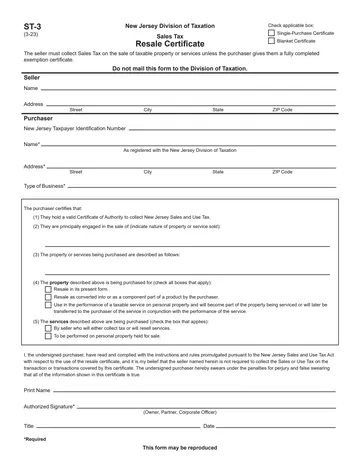
- Who completes it
- The purchaser, holding a New Jersey Certificate of Authority
- Given to
- The seller; not mailed to the Division
- Form revision
- ST-3 (3-23)
- Pages
- 1 page, with instructions on page 2
- Seller keeps it
- Four years from the last sale it covers
Form ST-3 (3-23) and its instructions.
At a glance
Form ST-3 is New Jersey's Resale Certificate. A business registered to collect New Jersey sales tax gives it to its supplier to buy property or services for resale without paying sales tax. The purchaser completes it; the seller accepts and keeps it. The current revision is ST-3 (3-23). The Division of Taxation posts it as a fillable PDF: Form ST-3, with the instructions on page 2.
- Who completes it. The purchaser, who must hold a New Jersey Certificate of Authority. Our New Jersey page summarizes it as: A valid New Jersey Certificate of Authority and New Jersey taxpayer identification number (ST-3).
- Where it goes. To the seller. The form says “Do not mail this form to the Division of Taxation.”
- Single or blanket. One form does both: the box at the top right decides.
- Who may accept it. “A seller must be registered to accept an exemption certificate.”
- Other forms. “in most circumstances purchasers may issue and New Jersey sellers may accept the Streamlined Sales and Use Tax Agreement Certificate of Exemption (Form ST-SST) in lieu of the general use exemption certificates made available by the Division” (S&U-6). Out-of-state sellers not required to register use Form ST-3NR.
New Jersey's rules on the certificate (timing, good faith, records, drop shipments, other exemption certificates) are on our New Jersey resale certificate page. This page walks the form line by line, using the form's own instructions and the Division's bulletin S&U-6, Sales Tax Exemption Administration (Rev. 6/24).
Tap a box once for its note, again to jump to the line. Zoom in to read the small print.
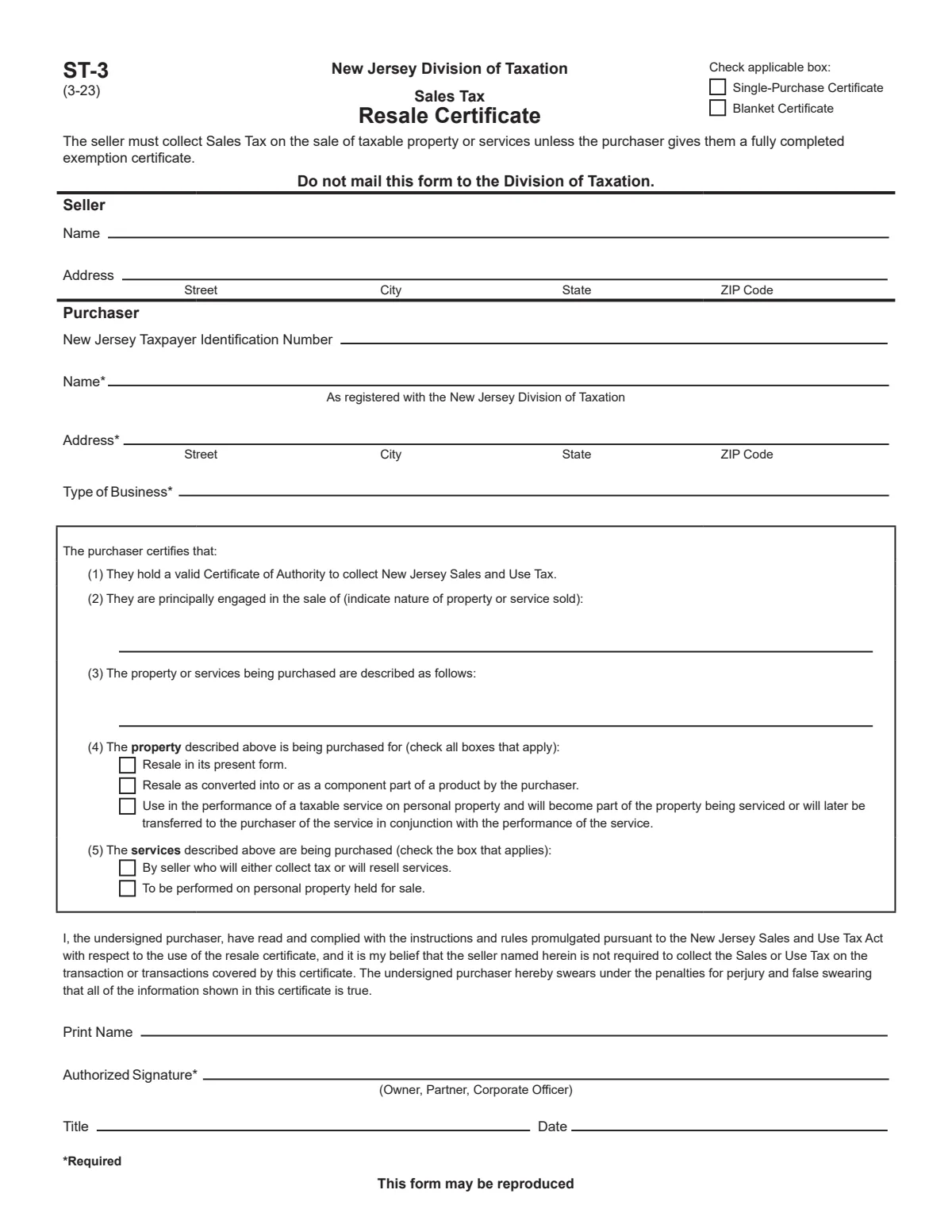
Certificate type, seller and purchaser
The top of the form has the certificate type, then the seller block, then the purchaser block. The asterisks mark required lines; the instructions add one more that the form does not mark.
| Line | Label | What goes there |
|---|---|---|
| Type | Check applicable box: Single-Purchase Certificate; Blanket Certificate | Check one. For a blanket certificate, New Jersey's instructions say a single certificate may cover additional purchases of the same general type of property by the same purchaser while the seller has a recurring business relationship, and “a recurring business relationship exists when a period of no more than 12 months elapses between sales transactions”. Every later invoice under a blanket certificate carries the purchaser's name, address and identification number (see Blanket certificates below). |
| Seller-name | Seller: Name | The seller's name. “The seller’s name and address are not required for the exemption certificate to be considered fully completed.” Filling it in still helps: it shows the certificate was given to this seller. |
| Seller-address | Seller: Address (Street, City, State, ZIP Code) | The seller's address. Optional, as above. |
| NJ-TIN | Purchaser: New Jersey Taxpayer Identification Number | The purchaser's New Jersey taxpayer identification number. The form prints no asterisk on this line, but the instructions list a New Jersey taxpayer identification number as one of the five items a fully completed certificate must have, so treat it as required. S&U-6 lets unregistered purchasers give a federal ID or another state's number on some certificates, but ST-3 is not on its list of certificates unregistered purchasers may issue; an out-of-state seller not required to register uses Form ST-3NR. |
| Name | Name* (As registered with the New Jersey Division of Taxation) | Required. The purchaser's name exactly as registered with the Division. |
| Address | Address* (Street, City, State, ZIP Code) | Required. The purchaser's address. |
| Business | Type of Business* | Required. In S&U-6's worked example, a gas station buying repair services from a transmission shop gives its business as gas station and mechanic. The seller reads it against the purchase: in an audit, good faith means the exemption claimed is reasonable for the purchaser's type of business (ST-3 instructions). |
Items (1) to (5): what the purchaser certifies
The boxed section is the reason for the exemption. Item (1) is a statement; items (2) and (3) are blanks; items (4) and (5) are check boxes, (4) for property and (5) for services.
| Line | Label | What goes there |
|---|---|---|
| 1 | (1) They hold a valid Certificate of Authority to collect New Jersey Sales and Use Tax. | A statement, not a blank. The Certificate of Authority (Form CA-1) is New Jersey's sales tax registration. S&U-6 says ST-3 is used by registered sellers. The purchaser registers through the state's business registration portal. |
| 2 | (2) They are principally engaged in the sale of (indicate nature of property or service sold): | What the purchaser principally sells, property or services. The seller reads it with the type of business line: what is being bought should fit what the purchaser sells. |
| 3 | (3) The property or services being purchased are described as follows: | What is being bought tax free. S&U-6 lists what ST-3 covers: inventory intended for resale, rent or lease, raw materials that become component parts of the finished product, services to inventory, and services for resale. |
| 4 | (4) The property described above is being purchased for (check all boxes that apply): | Three boxes: resale in its present form; resale as converted into or as a component part of a product; and use in performing a taxable service on personal property, where the property becomes part of the property serviced or is transferred to the customer with the service. Check every box that applies. |
| 5 | (5) The services described above are being purchased (check the box that applies): | Only when services are bought. Box one: by a seller who will collect tax or resell the services (S&U-6's example is a gas station sending a car to a transmission shop and then billing its customer tax on parts and labor). Box two: services performed on personal property held for sale (a car dealer's washes of vehicles in inventory). |
Certification and signature
| Line | Label | What goes there |
|---|---|---|
| Certification | I, the undersigned purchaser, have read and complied with the instructions ... | The purchaser states it has read the rules and believes the seller need not collect tax. “The undersigned purchaser hereby swears under the penalties for perjury and false swearing that all of the information shown in this certificate is true.” |
| Print-name | Print Name | The name of the person signing, printed. |
| Signature | Authorized Signature* (Owner, Partner, Corporate Officer) | Required. The instructions list the signature as required if using a paper exemption certificate (including fax). The printed note names who signs: an owner, partner or corporate officer. |
| Title | Title | The signer's title, matching the note under the signature line. |
| Date | Date | The date signed. “All certificates must be contemporaneously dated” (S&U-6). The 90 day window runs from the date of sale, not from this date. |
Fully completed: the five items
New Jersey's protection for the seller turns on a fully completed certificate. The instructions list what the purchaser must give: name and address; New Jersey taxpayer identification number; type of business; reason or reasons for exemption; and a signature, if using a paper certificate (including fax). The seller's own name and address are not on the list. A certificate missing any of the five is incomplete, and the seller is not protected by it until it is fixed.
Form ST-3 instructions; S&U-6 (Rev. 6/24).
Timing: the seller is relieved of liability as long as the certificate is fully completed and “is received within 90 days of the date of sale”. Our state page states it as: Within 90 days of the sale; at least 120 days after a Division request for substantiation on audit. In an audit, a seller without a certificate, or with an incomplete one, has at least 120 days after the Division's request to obtain a fully completed certificate taken in good faith, or other information showing the sale was not taxable. Good faith in that audit setting means the exemption was available by statute on the date of the sale, could apply to the property or service, and is reasonable for the purchaser's type of business. See good faith and the 90 and 120 day windows for every state.
Blanket certificates
A blanket ST-3 covers later purchases of the same general type of property while the relationship recurs. Two rules come with it. First, the invoices: “Each subsequent sales slip or purchase invoice based on the blanket certificate must be clearly marked with the purchaser’s name, address, and identification number.” Second, renewal: the Division may not ask the seller to renew a blanket certificate while the relationship recurs, but S&U-6 says “it is recommended that a seller obtain updated versions every four years”. Our state page carries it as: No renewal while the relationship is recurring (no more than 12 months between sales); updated certificates recommended every four years (S&U-6). When more than 12 months pass with no sale, the relationship is no longer recurring and a new certificate is the safe course. Compare other states on our resale certificate expiration by state page.
What the seller does with it
- Accept it only if registered. A seller must itself be registered to accept an exemption certificate.
- Check the five items and the type of business against what is being bought.
- Keep it. “Certificates must be retained by the seller for four years from the date of the last sale covered by the certificate.” The certificate must be in the seller's physical possession and available for inspection, and a seller that enters the data from a paper certificate into an electronic format need not keep the paper (ST-3 instructions). See how long to keep resale certificates.
- Verification. New Jersey's form and bulletin name no public lookup for a purchaser's number: our state page shows the lookup as Not listed. Our verification page lists every state's lookup.
- If the claim was wrong. “A purchaser who claims an improper exemption is responsible for paying any tax, interest, and penalties.” (S&U-6). The certificate is sworn under the penalties for perjury and false swearing.
Proper and improper use
The instructions give three proper uses: an appliance store buying appliances to resell, a furniture maker buying lumber for furniture it sells, and a service station buying auto parts for customers' cars. They give five improper ones, in each of which the seller must collect tax: a tire dealer buying lumber to alter its premises; a distributor buying cleaning supplies for its own office, even though it distributes them; a retailer buying office equipment for its own use, even though it sells office equipment; a service station buying tools and testing equipment; and a contractor buying materials and supplies. On the last: “A contractor cannot issue Form ST-3 for purchases of materials and supplies.” Contractors working for qualified exempt organizations use Form ST-13 or UZ-4 instead.
Items bought on ST-3 and later used by the business are taxed then: “When items purchased with Form ST-3 are taken out of inventory for personal use, the business must pay New Jersey Use Tax on the items that are not resold.”
How it connects
The New Jersey resale certificate page has the state's rules in full, including drop shipments (a supplier may accept ST-3, ST-SST, the MTC form, ST-3NR or an out-of-state retailer's home state certificate) and the other New Jersey certificates: Form ST-3NR for out-of-state sellers, ST-4 for exempt use, ST-5 for exempt organizations and ST-SST. For the general rules, see blanket and single-purchase certificates, what makes a resale certificate valid and the SST Certificate of Exemption. Other forms on the form itself: Illinois CRT-61, Texas 01-339 and Georgia ST-5.
Common questions
Do I mail Form ST-3 to the New Jersey Division of Taxation?
No. The form says not to mail it to the Division. The purchaser gives it to the seller, and the seller keeps it four years from the last sale it covers.
Does the seller's name have to be on ST-3?
No. The instructions say the seller's name and address are not required for the certificate to be fully completed. The five required items are the purchaser's name and address, New Jersey taxpayer ID, type of business, reason for exemption, and a signature on a paper or faxed certificate.
How long is a blanket ST-3 good for?
It runs while the relationship recurs, meaning no more than 12 months pass between sales, and the Division may not demand a renewal in that time. S&U-6 recommends getting an updated version every four years.
Can an out-of-state business use ST-3?
ST-3 is for purchasers holding a New Jersey Certificate of Authority. An out-of-state seller that is not registered and not required to register in New Jersey uses Form ST-3NR with its registration from another state.
Can a contractor use ST-3?
No, not for materials and supplies. The instructions list it as an improper use. A contractor working for a qualified exempt organization, an Urban Enterprise Zone business or a qualified housing sponsor uses Form ST-13 or UZ-4.
Can I use the Streamlined certificate instead of ST-3?
In most cases, yes. S&U-6 says purchasers may issue and New Jersey sellers may accept Form ST-SST in place of the general use certificates, fully completed with a New Jersey taxpayer ID, a federal employer ID, a foreign ID or, for an individual, a driver's license number.