- MTC form
- 38 rows: 37 states and Alaska's ARSSTC
- SST form
- 24 member states (23 full, 1 associate)
- Both
- 21 states
- Neither
- NY, LA, MA, MS, VA, DC
Two forms, two sets of states
There is no single resale certificate that every state accepts. A buyer that purchases for resale from sellers in many states has two multistate forms to choose from, and each works only in its own set of states, on its own terms.
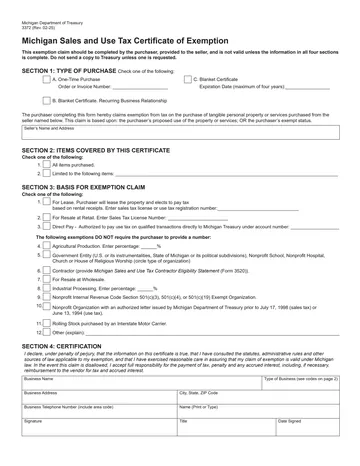
The first is the Multistate Tax Commission's Uniform Sales & Use Tax Resale Certificate, Multijurisdiction (PDF). The MTC's page says it is a form “that 36 States have indicated can be used as a resale certificate”, and the form itself, “revised as of October 14, 2022”, carries a state grid with 38 rows: 37 states and the Alaska Remote Sellers Sales Tax Commission (ARSSTC). Most rows carry a numbered note that limits how the state takes the form. It is a resale form: “If the Buyer purchases tax free for a reason other than resale, ingredient or component exemption, the Buyer cannot use this form”.
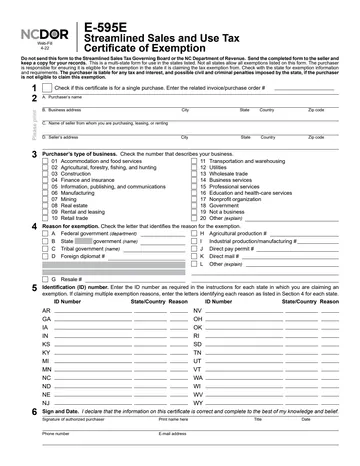
The second is the Streamlined Sales Tax Governing Board's Certificate of Exemption, Form F0003 (PDF). The Board says “The Streamlined Sales Tax® Exemption Certificate and instructions are accepted by all 24 Streamlined member states.” It covers resale and the other exemptions listed on the form, though “Not all states allow all exemptions listed on this form.”
MTC Uniform Sales & Use Tax Resale Certificate (revised Oct. 14, 2022), page 1; SST state information and exemption certificate page. Counts as of November 2026.
The two lists overlap. 21 states appear on both, 17 rows appear only on the MTC form, 3 states take only the SST form, and 6 jurisdictions with a sales tax take neither. The states without a general sales tax (Delaware, Montana, New Hampshire and Oregon) appear on neither list; Alaska has no state sales tax but appears on the MTC form through the ARSSTC row, for the local taxes its member communities levy.
The forms side by side
The forms differ in more than their state lists. The SST form is a full exemption certificate with reason codes, a single-purchase box and an ID number grid for each member state; the MTC form is a resale certificate with one line per state for the buyer's registration number and a page of state notes. The table compares what each one says.
| MTC uniform resale certificate | SST Certificate of Exemption (F0003) | |
|---|---|---|
| Published by | Multistate Tax Commission | Streamlined Sales Tax Governing Board |
| Current version | Revised Oct. 14, 2022 | Revised 12/21/2021 |
| States | 38 rows: 37 states plus Alaska's ARSSTC (the MTC's page says 36) | 24 member states (23 full, Tennessee associate) |
| What it covers | Resale, and ingredients or components of a product for resale | Resale and the other exemptions on the form (A to M), where the state allows them |
| Blanket use | Valid until canceled in writing or revoked; some notes set a term | Blanket unless the single-purchase box is checked; no renewal while purchases are no more than 12 months apart |
| Seller's deadline | At the purchase or as soon as possible; state notes vary (90 days in KS, OH, OK) | At the sale or within 90 days; 120 days after an audit request |
| Buyer's number | The registration number each state issued, unless the state's note allows another | That state's number if registration is required; else any state's number, then FEIN, other state ID or driver's license |
| Verification | No general rule; FL, IL, MD and ARSSTC notes name a lookup or a check | Not required of the seller (the form notes Georgia) |
Two differences matter most to a seller. First, the SST form carries a uniform seller relief rule written into every member state's law: the seller is not liable if the purchaser improperly claims an exemption, provided “The fully completed exemption certificate is provided to the seller at the time of sale or within 90 days subsequent to the date of sale”, the seller did not fraudulently fail to collect tax, and the seller did not solicit the claim. The MTC form has no uniform relief rule; each state's own law decides, and the MTC says only that “A Seller failing to exercise care could be held liable for the sales tax due in some states.”
Second, the number the buyer writes. On the SST form, a buyer not registered in a member state may give “your sales tax ID number issued by any state”, and the seller “is not required to verify the purchaser's ID number or determine the purchaser's registration requirements.” On the MTC form, the line next to each state takes “the sales/use tax registration or resale authorization number issued by the state”, and several state notes insist on their own number: Maryland, Illinois, Kansas and Vermont among them.
SST exemption certificate page; MTC form, pages 1 to 6; each state's row on this site. A permit number without a certificate is not a certificate in most states.
Which states take which form
As of November 2026, the lists read as follows. Each state name links to its state page, which quotes the state's own rule.
- Both forms (21): Arkansas, Georgia, Iowa, Kansas, Kentucky, Michigan, Minnesota, Nebraska, Nevada, New Jersey, North Carolina, North Dakota, Ohio, Oklahoma, Rhode Island, South Dakota, Tennessee, Utah, Vermont, Washington and Wisconsin.
- The MTC form only (17 rows): Alabama, Alaska, Arizona, California, Colorado, Connecticut, Florida, Hawaii, Idaho, Illinois, Maine, Maryland, Missouri, New Mexico, Pennsylvania, South Carolina and Texas.
- The SST form only (3): Indiana, West Virginia and Wyoming. Wyoming goes furthest: “the Streamlined Sales and Use Tax Agreement exemption certificate is the only exemption certificate approved in Wyoming”.
- Neither form (6): District of Columbia, Louisiana, Massachusetts, Mississippi, New York and Virginia.
- No general sales tax: Delaware, Montana, New Hampshire and Oregon; Alaska's local taxes are covered by the ARSSTC row on the MTC form.
A state on the MTC list is not always a clean yes. Of the 38 rows, 30 come with conditions, such as Florida's authorization number, Maryland's own registration number, or resale of goods only. Maine is the sharpest case: the form lists Maine, but Maine's statute exempts only sales “to a retailer that has been issued a resale certificate pursuant to section 1754”, a certificate Maine Revenue Services issues. The statute governs. The MTC certificate page quotes all 32 notes and the conflicts between the notes and the states' own texts.
States that take neither form
In these states a seller needs the state's own certificate or document, whatever multistate form the buyer offers.
| State | MTC form | SST | What the state's texts say |
|---|---|---|---|
| District of Columbia | Not listed | Not a member | Not on the MTC form's state list; OTR recognizes only resale certificates on forms it authorizes (9 DCMR 414.2) |
| Louisiana | Not accepted | Not a member | LDR does not accept the multistate exemption certificate; Louisiana is not on the MTC form's state list |
| Massachusetts | Not listed | Not a member | Not on the MTC form's state list |
| Mississippi | Not listed | Not a member | Not on the MTC form's state list; the DOR does not accept blanket certificates and asks for a DOR-issued permit or exemption letter |
| New York | Not accepted | Not a member | Not on the MTC form's state list; other states' exemption certificates are not valid in New York (TB-ST-240) |
| Virginia | Not listed | Not a member | Not on the MTC form's state list |
New York states the rule most plainly: “Exemption certificates of other states or countries are not valid to claim exemption from New York State and local sales and use tax.” (TB-ST-240). Louisiana's FAQ is just as direct: “Louisiana does not accept other state exemptions or the multi-state exemption certificate.” For a buyer in another state, these states also limit which out-of-state numbers count; the out-of-state certificates page has every state's rule in one table.
Rules that apply whichever form you use
The state where the sale is sourced decides. Neither body decides whether a certificate is good. The MTC's FAQ says “The Multistate Tax Commission does not determine whether this certificate will be accepted either by the Seller or the applicable state.” The applicable state “will generally be the state where the Seller is located or has nexus or the state where the sales transaction took place, or where the Buyer is located.” The SST form asks for the ID number required by the state to which the sale is sourced (Rule 317.1.A.1).
A multistate form does not replace registration. The MTC's instructions say “Generally, a Buyer must be registered as a retailer for sales/use tax in states where the Buyer has sales/use tax nexus.” Registration is a separate step with each state, or through the SST's registration system for member states: the Board says “You do not need to be registered through the Streamlined Sales Tax® Registration System to use the Streamlined Exemption Certificate.”
Neither form is filed with anyone. The buyer gives it to the seller. The SST form says “Do not send this form to the Streamlined Sales Tax Governing Board.” The MTC's FAQ tells a seller that receives one: “Once you have examined the certificate and you have accepted it, you will keep it on file as prescribed by applicable state laws.” Record periods by state are on the records page.
Misuse falls on the buyer. The MTC form warns that “Misuse of this certificate by Buyer, Seller, lessor, lessee, or the representative thereof may be punishable by fine, imprisonment or loss of right to issue or accept a certificate in some states or cities.” The SST form says “The purchaser is liable for any tax and interest, and possible civil and criminal penalties imposed by the state, if the purchaser is not eligible to claim this exemption.”
Remote sellers. Since South Dakota v. Wayfair (2018), a seller with no store in a state may still have to collect that state's tax, and so must take certificates for that state's exempt sales. The SST's drop shipper instructions note that “a retailer or marketplace seller may only be required to register for sales tax in one state”, which is why the SST form lets one state's number serve in many states. The remote sellers page covers the rest.
Pages in this section
- The MTC uniform resale certificate: the form, all 32 state notes quoted, the 36 or 38 count, and where a state's own law differs.
- The SST Certificate of Exemption (Form F0003): the 24 member states, sections 1 to 6, the 90-day and 120-day relief, the 12-month blanket rule.
- Out-of-state resale certificates: whether each state takes another state's number, the MTC form or the SST form, in one table.
- Remote sellers after Wayfair: what changed for certificates when physical presence stopped being the test.
Forms, line by line
Tools for this topic
Common questions
Is there one resale certificate that works in every state?
No. The MTC form lists 37 states plus Alaska's ARSSTC, and the SST form covers the 24 member states. New York, Louisiana, Massachusetts, Mississippi, Virginia and DC take neither, and many states on the MTC list add conditions.
Which is better for a buyer, the MTC form or the SST form?
In an SST member state, the SST form: every member must accept it, it covers more than resale, and it lets a buyer that is not registered in the state give another state's number. Outside the SST states, the MTC form is the only multistate option, and only in the states on its grid.
Does the seller have to accept a multistate form?
The MTC's FAQ says “The Seller will determine whether it will accept the certificate from the Buyer.” SST member states must accept the SST form, but a seller can still ask for the state's own form; both are valid.
Do I file the MTC or SST form with a state?
No. The buyer gives it to the seller, and the seller keeps it. “Do not send exemption certificates to the Streamlined Sales Tax Governing Board or to the states.”
Is the MTC form still the October 2022 version?
Yes, as of November 2026. The MTC's FAQ says the most recent version is the one on its website, “revised as of October 14, 2022”, and warns against modified copies.
Sources
- Multistate Tax Commission, Uniform Sales & Use Tax Resale Certificate, Multijurisdiction (form revised Oct. 14, 2022, with its instructions, notes 1 to 32 and FAQ) and the FAQ on the uniform certificate
- Streamlined Sales Tax Governing Board, Exemptions: Certificates, Form F0003 (PDF) (Revised 12/21/2021) and state information (member states)
- Streamlined Sales and Use Tax Agreement, Section 317, and Governing Board Rule 317.1, amended through Oct. 15, 2026, on the Board's Streamlined Agreement and Rules page
- Maine Revised Statutes, 36 M.R.S. 1752; New York, TB-ST-240; Wyoming Department of Revenue, Exemption Matrix; Louisiana Department of Revenue, exemption certificate FAQ