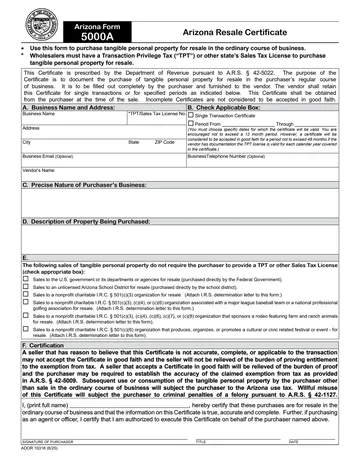
- At a glance
- The statute behind it
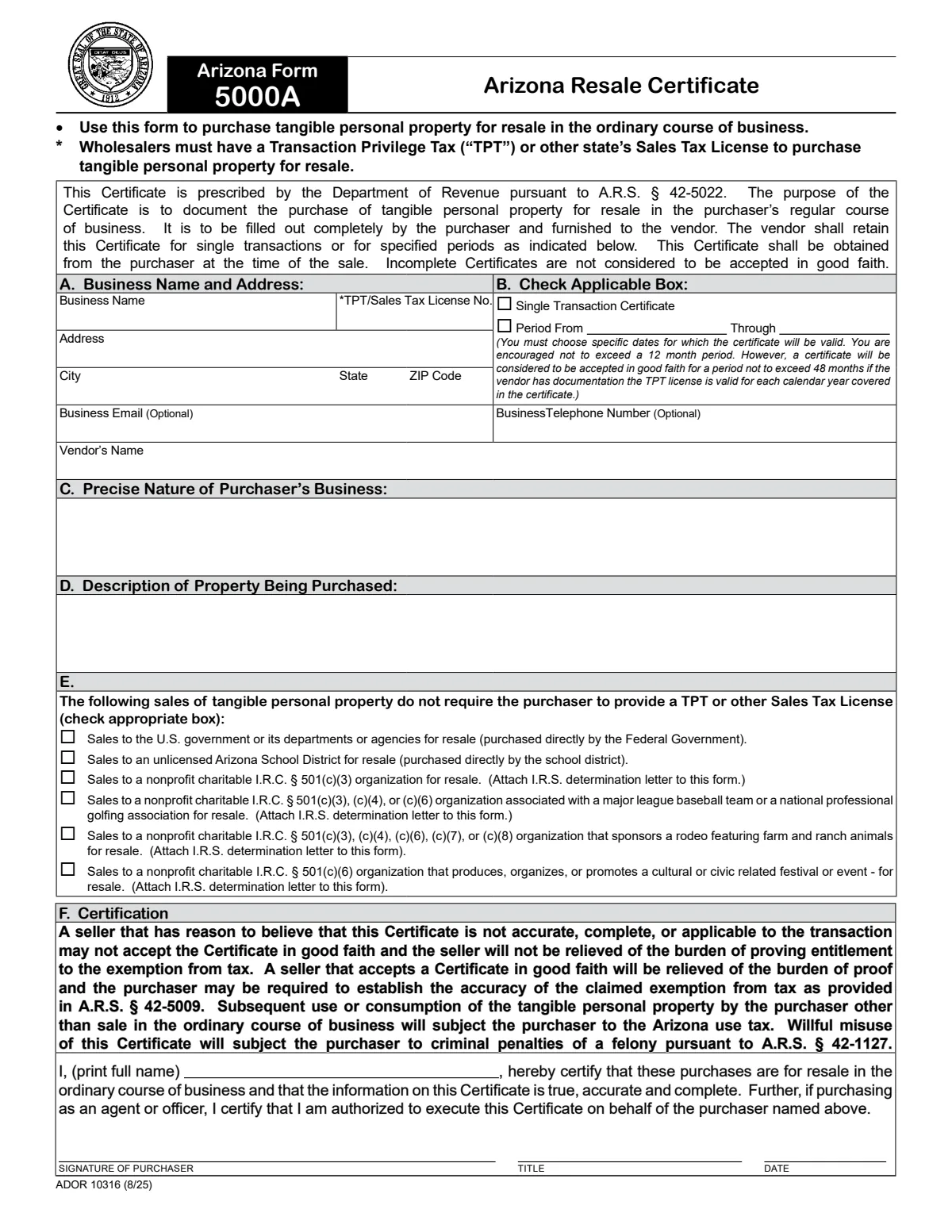
- The form, with hotspots
- Section A: the buyer and the vendor
- Section B: single sale or period
- Sections C and D: business and property
- Section E: buyers that need no license
- Section F: certification
- The vendor's side
- Other forms Arizona accepts
- How it connects
- Common questions
- Sources
- Who completes it
- The purchaser
- When
- At the time of the sale
- Kept by
- The vendor, for the period covered; not sent to ADOR
- Form revision
- ADOR 10316 (8/25)
- Pages
- 1
At a glance
Form 5000A is the Arizona Resale Certificate. In the form's words: “Use this form to purchase tangible personal property for resale in the ordinary course of business.” Arizona's tax is the transaction privilege tax (TPT), levied on the vendor, so the certificate is the vendor's proof that a sale was not a retail sale. Arizona's rules for every certificate are on the Arizona resale certificate page; this page walks the form.
- Who completes it. The purchaser. The purchaser fills it out completely and gives it to the vendor; it is not sent to ADOR: “The form does not need to be sent to the Arizona Department of Revenue.”
- The form. Form 5000A, printed revision ADOR 10316 (8/25), one page with Sections A to F.
- When. At the sale.
- How long. The period written on the certificate (12 months or less encouraged); good faith up to 48 months with a yearly license check.
- Complete or nothing. “Incomplete Certificates are not considered to be accepted in good faith.”
The statute behind it
The form is prescribed under A.R.S. 42-5022, which puts the burden of proof on the vendor unless “The person has taken from the purchaser a certificate signed by and bearing the name and address of the purchaser that the property was purchased for resale in the ordinary course of business and that he has a valid license, with the number thereof, to sell the kind of property purchased.” A.R.S. 42-5009(O) sets the effect of good faith: “A vendor that accepts a certificate in good faith will be relieved of the burden of proof and the purchaser may be required to establish the accuracy of the claimed exemption.” ADOR's procedure TPP 17-1 explains how the Department applies both.
Tap a box once for its note, again to jump to the line. Zoom in to read the small print.
Section A: the buyer and the vendor
Section A identifies the purchaser, its license number and the vendor. Email and phone are the only optional boxes on the form.
| Box | As printed | What goes there |
|---|---|---|
| A-name | A. Business Name and Address: Business Name | The purchaser's name. A.R.S. 42-5022 requires a certificate “signed by and bearing the name and address of the purchaser”. |
| A-license | *TPT/Sales Tax License No. | The asterisk points to the note at the top: “Wholesalers must have a Transaction Privilege Tax (‘TPT’) or other state’s Sales Tax License to purchase tangible personal property for resale.” TPP 17-1: “The Department accepts valid out-of-state sales tax license numbers for resale purposes only.” An Arizona number can be checked on AZTaxes License Verification. |
| A-address | Address | Part of the name and address the statute requires (A.R.S. 42-5022). |
| A-city | City, State, ZIP Code | The rest of the address. An out-of-state buyer gives its own state, which should match the state that issued its license number. |
| A-email | Business Email (Optional) | Optional, as printed. A way for the vendor to reach the buyer about the certificate. |
| A-phone | BusinessTelephone Number (Optional) | Optional, as printed. |
| A-vendor | Vendor’s Name | The vendor the buyer gives the certificate to. The form “is to be filled out completely by the purchaser and furnished to the vendor.” |
Section B: single sale or period
Check one. The period choice is where Arizona differs from most states: there is no open-ended blanket certificate.
| Box | As printed | What goes there |
|---|---|---|
| B-single | B. Check Applicable Box: Single Transaction Certificate | For one purchase. The vendor “shall retain this Certificate for single transactions or for specified periods as indicated below.” |
| B-period | Period From ... Through ... | “You must choose specific dates for which the certificate will be valid.” “However, a certificate will be considered to be accepted in good faith for a period not to exceed 48 months if the vendor has documentation the TPT license is valid for each calendar year covered in the certificate.” TPP 17-1 warns that an open-ended period “may not be considered commensurate with the acceptance of a certificate in good faith.” |
Sections C and D: business and property
These two boxes are how the vendor judges good faith: the goods in D should be the kind the business in C resells.
| Box | As printed | What goes there |
|---|---|---|
| C | C. Precise Nature of Purchaser’s Business: | A specific description, not just retail. TPP 17-1 lists “The precise nature of the purchaser’s business;” among the information every exemption certificate must give. Its car dealer example shows why: a carpet layer claiming resale on a car is not accepted in good faith when the vendor knows its business. |
| D | D. Description of Property Being Purchased: | The goods covered. One type of exemption per certificate: “A separate exemption certificate is not required for every item purchased if the items fall within the limits of the certificate.” |
Section E: buyers that need no license
| Box | As printed | What goes there |
|---|---|---|
| E | E. The following sales of tangible personal property do not require the purchaser to provide a TPT or other Sales Tax License (check appropriate box): | Most buyers skip Section E. It lists six kinds of buyer that may buy for resale without a license number; the 501(c) boxes require the IRS determination letter attached. |
| E-1 | Sales to the U.S. government or its departments or agencies for resale (purchased directly by the Federal Government). | Only when the federal government buys directly. Federal purchases in general: federal government purchases. |
| E-2 | Sales to an unlicensed Arizona School District for resale (purchased directly by the school district). | For a school district that buys for resale and holds no TPT license. |
| E-3 | Sales to a nonprofit charitable I.R.C. § 501(c)(3) organization for resale. (Attach I.R.S. determination letter to this form.) | Attach the IRS determination letter. See 501(c)(3) sales tax exemption. |
| E-4 | Sales to a nonprofit charitable I.R.C. § 501(c)(3), (c)(4), or (c)(6) organization associated with a major league baseball team or a national professional golfing association for resale. | Attach the IRS determination letter. |
| E-5 | Sales to a nonprofit charitable I.R.C. § 501(c)(3), (c)(4), (c)(6), (c)(7), or (c)(8) organization that sponsors a rodeo featuring farm and ranch animals for resale. | Attach the IRS determination letter. |
| E-6 | Sales to a nonprofit charitable I.R.C. § 501(c)(6) organization that produces, organizes, or promotes a cultural or civic related festival or event for resale. | Attach the IRS determination letter. |
Section F: certification
| Box | As printed | What goes there |
|---|---|---|
| F | F. Certification | “A seller that has reason to believe that this Certificate is not accurate, complete, or applicable to the transaction may not accept the Certificate in good faith and the seller will not be relieved of the burden of proving entitlement to the exemption from tax.” “Willful misuse of this Certificate will subject the purchaser to criminal penalties of a felony pursuant to A.R.S. § 42-1127.” |
| F-name | I, (print full name) ____, hereby certify ... | The signer certifies “that these purchases are for resale in the ordinary course of business and that the information on this Certificate is true, accurate and complete.” An agent or officer also certifies authority to sign for the purchaser. |
| F-sign | SIGNATURE OF PURCHASER | Required: A.R.S. 42-5022 calls for a certificate signed by the purchaser, and TPP 17-1 asks for the “Signature of a person authorized to sign on behalf of or as representative for the purchaser.” |
| F-title | TITLE | The signer's role, which supports the authority statement in F. |
| F-date | DATE | The form says it “shall be obtained from the purchaser at the time of the sale.” |
The vendor's side
Form 5000A; TPP 17-1. The amber step: TPP 17-1's car dealer example is a certificate that was complete but not in good faith.
- What to check. TPP 17-1: a vendor may accept the certificate if it is complete, contains all required information, and all its information appears to be accurate. “‘Good faith’ means with honesty and with no knowledge of circumstances that should cause the vendor to deny the exemption claimed on the exemption certificate.”
- Mark the invoice. A.R.S. 42-5009(A) also asks the vendor to mark the invoice. TPP 17-1's note: “a vendor may either record the customer’s TPT license number on the invoice or cross reference the specific transaction to the specific exemption certificate of the specific customer.”
- Keep it. “The vendor must retain a copy of the exemption certificate on file at all times during the time period specified on the certificate.” Keep records for the assessment period of A.R.S. 42-1104, generally four years after the return is due or filed, whichever is later (A.R.S. 42-1105(D)); keep the certificate on file for the whole period it covers (TPP 17-1).
- Refusing later. A vendor “may refuse to honor an exemption certificate, even after accepting it in good faith, if the vendor later learns the information contained in the certificate is no longer true”.
- Misuse. Willful misuse is a felony under A.R.S. 42-1127 (a first offense may be a class 1 misdemeanor); the purchaser owes the tax, penalty and interest (A.R.S. 42-5009(O)). See misuse penalties by state.
Other forms Arizona accepts
A vendor may take the MTC's uniform certificate, but only for resale: Resale of tangible personal property only, not other deductions or exemptions; must show an Arizona TPT or other state license number (TPP 17-1; A.R.S. 42-5022). TPP 17-1 also names the Border States Uniform Sale for Resale Certificate (Form 60-0081) for goods that cross state or national borders. Any other alternative form must contain all the required information, and “a vendor's acceptance of an alternative form may subject the vendor to a greater burden of proof than if the vendor had accepted a Department or Department pre-approved certificate form”. The Streamlined certificate: Not on ADOR's pre-approved list; a vendor accepting an alternative form may carry a greater burden of proof (TPP 17-1).
Drop shipments: The primary seller is exempt when the secondary seller gives a valid resale certificate; an out-of-state license number may be used (TPR 95-13). ADOR's ruling TPR 95-13 is older than the current statutes; where it and TPP 17-1 differ, TPP 17-1 and the current statutes govern (see the Arizona page and drop shipments).
How it connects
- Arizona's rules, the TPT license and the other Arizona certificates (Form 5000 for exemptions other than resale): Arizona resale certificate.
- Expiration in every state: resale certificate expiration; checking a number: verify a resale certificate.
- Buyers from other states: out-of-state resale certificates. The MTC form: MTC uniform certificate.
- Other form pages: California CDTFA-230, Michigan Form 3372, New York ST-120.
Common questions
How long is an Arizona resale certificate valid?
For the single sale or the dates written in Section B. ADOR encourages 12 months or less; good faith up to 48 months with a yearly license check (TPP 17-1).
Can a buyer from another state use Form 5000A?
Yes. The license number box takes an Arizona TPT license or another state's sales tax license number; ADOR accepts valid out-of-state numbers for resale only (TPP 17-1).
Does the vendor send Form 5000A to ADOR?
No. The vendor keeps it on file for the whole period it covers; ADOR's form page says it does not need to be sent to the Department.
Can one Form 5000A cover resale and another exemption?
No. Only one type of exemption may be claimed per certificate. Exemptions other than resale go on Form 5000 or the other ADOR certificates.
Is the MTC uniform certificate accepted in Arizona?
For resale of goods only, complete and signed, with an Arizona TPT or other state's license number. It does not support other deductions or exemptions (TPP 17-1).
Sources
- Arizona Department of Revenue, Form 5000A, Arizona Resale Certificate, ADOR 10316 (8/25); the Arizona Resale Certificate form page
- A.R.S. 42-5022 and A.R.S. 42-5009
- ADOR, TPP 17-1, Procedure for Use of Exemption Certificates; TPR 95-13, drop shipments