- At a glance
- The form, with hotspots
- Steps 1 and 2: seller and purchaser
- The purchaser's number: the two boxes
- Steps 3 to 5: one purchase or a blanket
- Step 6: the purchaser's signature
- The three year update: should or must
- What the seller does with it
- Mistakes the form invites
- How it connects
- Common questions
- Sources
- Who completes it
- The purchaser, at the seller's request
- Given to
- The seller; not mailed to IDOR
- Form revision
- CRT-61 (R-04/25)
- Pages
- 1 page, with 2 pages of instructions
- Seller keeps it
- At least three and one-half years
CRT-61 and its instructions (R-04/25); 86 Ill. Adm. Code 130.1405(c)(1).
At a glance
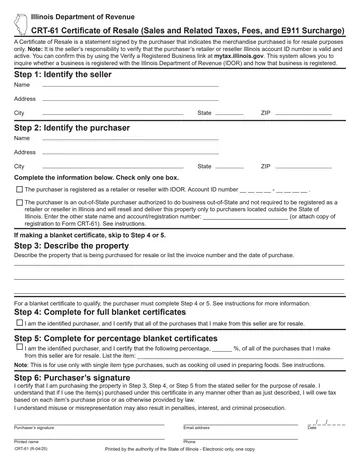
Form CRT-61 is the Illinois Department of Revenue's Certificate of Resale. The purchaser fills it out and signs it, and gives it to the seller, so the seller can sell without charging Retailers' Occupation Tax on property the purchaser will resell, lease or rent. It is a one page form in six steps. The current revision is CRT-61 (R-04/25), and IDOR posts it as a fillable PDF: Form CRT-61, with two pages of instructions.
- Who completes it. The purchaser, when the seller asks: “The purchaser, at the seller’s request, must provide the required information to complete this certificate.”
- Where it goes. To the seller. “Unless otherwise directed, do not mail the Certificate of Resale to IDOR.” The seller keeps it for not less than three and one-half years as proof that no tax was due.
- Optional form. Any statement with the items the rule lists works in its place (86 Ill. Adm. Code 130.1405(b)). “A purchase order signed by the purchaser may be used as a Certificate of Resale if it contains all of the above required information.”
- Leases. Since Jan. 1, 2025, leases and rentals are taxable in Illinois, and a lessor buying property to lease uses the same form: “you may use Form CRT-61, Certificate for Resale, to claim an exemption from Sales and Use Tax on purchases of merchandise that will be leased or rented” (IDOR Bulletin FY 2025-15).
The rules behind the form (who must register, the presumption when no number is given, the misuse penalty, drop shipments, records) live on our Illinois resale certificate page. This page walks the form itself.
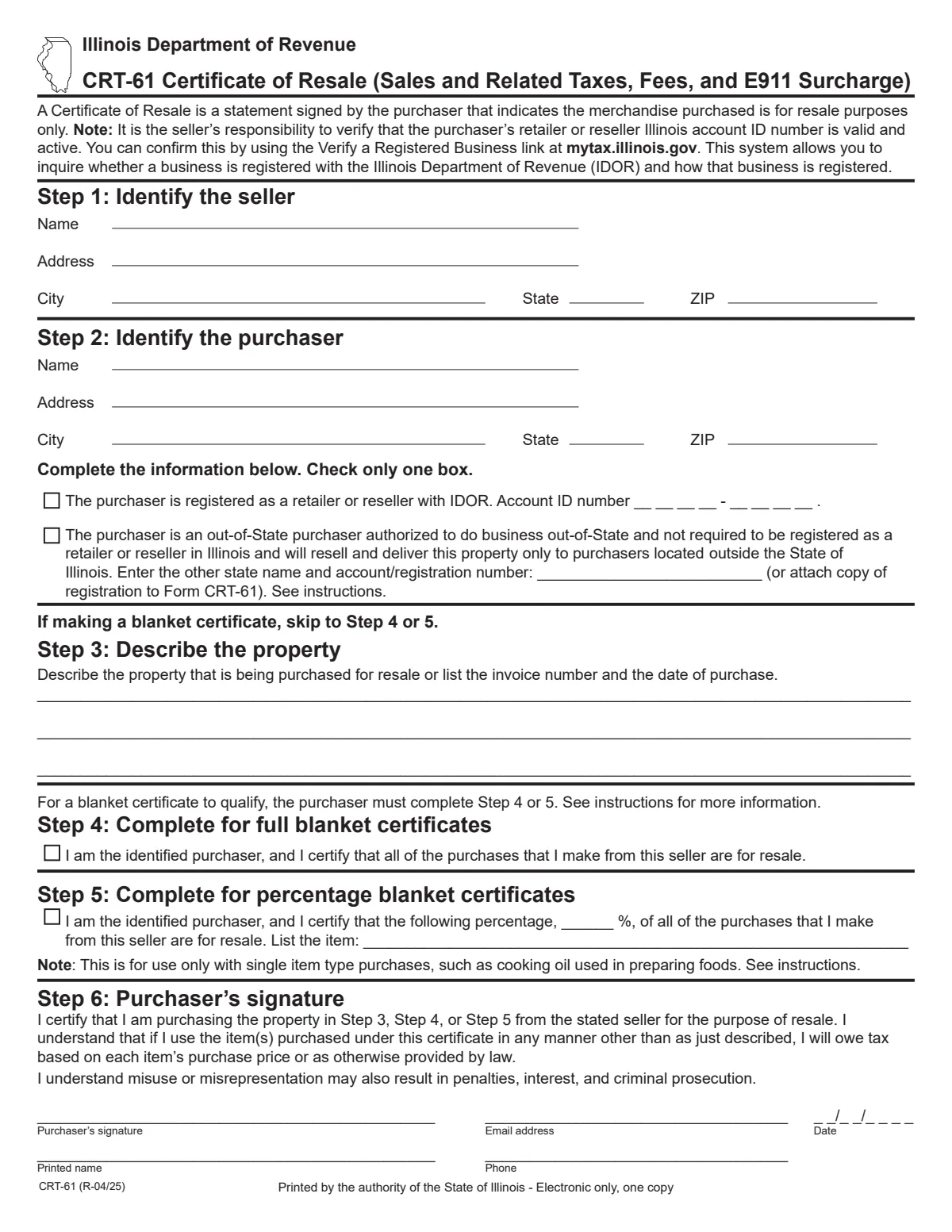
Tap a box once for its note, again to jump to the line. Zoom in to read the small print.
Steps 1 and 2: seller and purchaser
The top half names the two parties. The instructions ask for a mailing address for each. The note printed above Step 1 is not a line to fill in, but it is the line the seller should read first.
| Line | Label | What goes there |
|---|---|---|
| Note | Note (printed above Step 1) | The form opens with the seller's job: “It is the seller’s responsibility to verify that the purchaser’s retailer or reseller Illinois account ID number is valid and active.” The same sentence is repeated in the instructions under Step 2. The check is MyTax Illinois's Verify a Registered Business search, which takes an account ID, FEIN or license number and tells whether and how a business is registered with IDOR. Illinois does not use a good faith test here: the seller confirms an active number (see the Illinois page for the rule). |
| 1-name | Step 1: Name | The seller's name. The instructions: enter the seller's name and mailing address. The seller is the business that sells tax free and keeps the certificate as its proof. |
| 1-address | Step 1: Address | The seller's mailing address, street line. |
| 1-city | Step 1: City, State, ZIP | The rest of the seller's address. The seller's name and address are on the rule's list of items every Certificate of Resale must contain (86 Ill. Adm. Code 130.1405(b)(1)), so a certificate with Step 1 blank is incomplete. |
| 2-name | Step 2: Name | The purchaser's name. Use the name the purchaser is registered under with IDOR, so the seller's lookup matches. |
| 2-address | Step 2: Address | The purchaser's mailing address, street line. |
| 2-city | Step 2: City, State, ZIP | City, state and ZIP of the purchaser's mailing address (86 Ill. Adm. Code 130.1405(b)(2)). |
The purchaser's number: the two boxes
Step 2 ends with two check boxes, and the form says to check only one. The first is for a purchaser with an Illinois account ID; the second is for an out-of-state purchaser that never resells into Illinois. A purchaser that fits neither does not have the number Illinois requires. “Failure to present an active registration number or resale number and a certification to the seller that a sale is for resale creates a presumption that a sale is not for resale.” (35 ILCS 120/2c).
CRT-61 (R-04/25) and its instructions; 35 ILCS 120/2c; 86 Ill. Adm. Code 130.1405.
| Line | Label | What goes there |
|---|---|---|
| 2-registered | The purchaser is registered as a retailer or reseller with IDOR. Account ID number | The usual box. Enter the account ID in the blanks provided. Illinois makes a sale for resale tax free when the purchaser has an active registration number or resale number and gives it to the seller with the certification (35 ILCS 120/2c). The certificate of registration alone does not do it: “You cannot use your Certificate of Registration or License by itself to purchase items exempt from tax.” A resale number is the number IDOR issues to a reseller that makes no taxable Illinois sales; it goes here too. |
| 2-out-of-state | The purchaser is an out-of-State purchaser ... Enter the other state name and account/registration number | For a buyer that is authorized to do business in another state, is not required to register in Illinois, and will resell and deliver the property only to purchasers outside Illinois. Enter the other state's name and the buyer's number there, or attach a copy of the registration. The instructions say IDOR does not accept the purchaser's statement that property will be resold without supporting evidence, such as an Illinois account ID or proof of out-of-state registration. This box does not fit a drop shipment to an Illinois customer: see the drop shipment row in the mistakes below. |
Steps 3 to 5: one purchase or a blanket
The middle of the form decides what the certificate covers. The form tells a purchaser making a blanket certificate to skip to Step 4 or 5. So a single purchase certificate completes Step 3 only, a full blanket completes Step 4 only, and a percentage blanket completes Step 5 only. Our page on blanket and single-purchase certificates compares the two kinds across states.
| Line | Label | What goes there |
|---|---|---|
| 3 | Step 3: Describe the property | For a single purchase: briefly describe the tangible personal property bought for resale, or list the invoice number and date of purchase. Extra sheets may be attached. “Only complete Step 3, Step 4, or Step 5. Do not complete more than one step.” The description is a required item under 86 Ill. Adm. Code 130.1405(b)(3). |
| 4 | Step 4: Complete for full blanket certificates | Check the box when all of the purchaser's purchases from this seller are for resale. The rule allows a blanket certificate only on that condition (86 Ill. Adm. Code 130.1405(c)). A blanket certificate needs updating at least every three years (see the update rule below the table). |
| 5 | Step 5: Complete for percentage blanket certificates | Enter the percentage of purchases from this seller that are for resale and name the item. The instructions say this box is for commodity single item type purchases, such as cooking oil or coal, that are partly for resale and partly for use in production activities (86 Ill. Adm. Code 130.215), and that it may also state a percentage of all purchases from the seller. If the percentage changes, the purchaser gives a new certificate. |
Step 6: the purchaser's signature
Step 6 holds the certification and the purchaser's details. The certification ties the signature to whichever of Steps 3, 4 and 5 was completed, so a signed form with none of them completed certifies nothing in particular.
| Line | Label | What goes there |
|---|---|---|
| 6-cert | I certify that I am purchasing the property in Step 3, Step 4, or Step 5 ... for the purpose of resale. | The printed certification. The purchaser states that it buys the property in Step 3, 4 or 5 from the named seller for resale, that it will owe tax based on each item's purchase price if it uses an item any other way, and that misuse or misrepresentation may also bring penalties, interest and criminal prosecution. Knowingly using a registration or resale number to make a seller believe a purchase is for resale is a Class 4 felony (35 ILCS 120/13). |
| 6-sign | Purchaser's signature; Printed name | The rule accepts the purchaser's signature or that of an authorized employee or agent (86 Ill. Adm. Code 130.1405(b)(4)). Electronic signatures are allowed: a scanned or digitized image of a handwritten signature, a signature pad, a stylus on a screen, or software that requires dual (two-factor) authentication (instructions, Step 6). |
| 6-contact | Email address; Phone | The instructions: the purchaser must sign, print name, provide email and phone number, and date the form. Neither is on the rule's list of required items, but leaving them blank departs from the form's own instructions. |
| 6-date | Date | Month, day and year of signing. The date of signing is a required item (86 Ill. Adm. Code 130.1405(b)(4)). |
The three year update: should or must
How often a blanket certificate must be renewed is stated in three places, in two different words. Page 1 of the instructions says “all blanket certificates should be updated at least once every three years”. Page 2, under Step 5, says blanket and percentage blanket certificates “must be updated at least once every three years”. The rule says: “While there is no statutory requirement that blanket Certificates of Resale be renewed at certain intervals”, “blanket Certificates should be updated periodically, and no less frequently than every three years” (86 Ill. Adm. Code 130.1405(c)(1)). IDOR's certificate of resale page also uses should: certificates should be updated at least every three years.
The rule governs, and it says should, not must. In practice the answer is the same: get a new CRT-61 from each blanket customer at least every three years, and sooner when a Step 5 percentage changes. Our Illinois page states it as: Update blanket certificates at least every 3 years (86 Ill. Adm. Code 130.1405(c)(1)).
What the seller does with it
CRT-61 instructions (R-04/25); 86 Ill. Adm. Code 130.1405(c)(1).
- Check that it is complete. The rule's list: the seller's name and address, the purchaser's name and address, a description of the items, the purchaser's or an authorized agent's signature and the date, and the Illinois registration number, the resale number, or the out-of-state statement (86 Ill. Adm. Code 130.1405(b)). A complete certificate is prima facie proof that the sale was for resale, provided the statement is correct.
- Confirm the number. The form makes this the seller's job, and the MTC's Illinois note says the same in its own words: a retailer must confirm that the purchaser has a valid registration or resale number at the time of purchase. The seller does not have to follow the goods: “So long as the seller obtains a certificate of resale from the purchaser that contains all information required by Section 130.1405, the seller need not verify that the tangible personal property he sells for resale is actually resold.” (86 Ill. Adm. Code 130.1401(a)).
- Take it at the sale. The seller decides at the time of the sale whether it is for resale (86 Ill. Adm. Code 130.1401(a)). Our page on good faith and timing compares this with the 90 day window in other states.
- Keep it. Keep the certificate at least three and one-half years; electronic records OK (86 Ill. Adm. Code 130.805). See how long to keep resale certificates by state.
Mistakes the form invites
- Checking both Step 2 boxes, or completing two of Steps 3 to 5. The form and the instructions allow one of each.
- Handing over the certificate of registration instead. The registration certificate proves registration, not resale. The purchaser still signs a CRT-61 or an equivalent statement.
- Using the MTC form with another state's number. Illinois accepts the MTC certificate only with an Illinois registration or resale number; the MTC's Illinois note 12 says no other state's registration number is acceptable.
- The out-of-state box on a drop shipment into Illinois. The second box says the purchaser delivers only outside Illinois. A drop shipment to an Illinois customer does not fit it. The drop shipment rule lets an out-of-state purchaser with no Illinois contacts certify the drop shipment facts on a Certificate of Resale in place of a resale number, with a warning: “an Illinois auditor is much more likely to go behind a Certificate of Resale that does not contain a valid resale number” (86 Ill. Adm. Code 130.225(d)). The form has no box for that case, so the facts go in Step 3 or on an attachment. Our drop shipments page covers the multistate side.
- Using it for the purchaser's own supplies. The certification says the purchaser will owe tax on any other use, and knowingly using a number to make a seller believe a purchase is for resale is a Class 4 felony (35 ILCS 120/13).
How it connects
The Illinois resale certificate page has the state's rules in full: who must register, the misuse penalty, drop shipments, other Illinois exemption certificates (such as CRT-63 for building materials and ST-587 for manufacturing), and the MTC note 12 conflict on leases. For the general rules, see what makes a resale certificate valid, how to verify a resale certificate and the MTC uniform certificate. Other forms on the form itself: New Jersey ST-3, Texas 01-339 and Georgia ST-5.
Common questions
Do I send Form CRT-61 to the Illinois Department of Revenue?
No. The purchaser gives it to the seller, and the seller keeps it at least three and one-half years. IDOR may ask for it on audit. The instructions say not to mail it to IDOR unless otherwise directed.
Can a purchase order be used instead of CRT-61?
Yes, if the purchaser signs it and it has every item a Certificate of Resale must contain: both names and addresses, a description of the property, a statement that it is for resale, the signature and date, and the Illinois account ID, resale number or out-of-state certification.
How often does a blanket CRT-61 have to be renewed?
At least every three years. The rule says blanket certificates should be updated no less often than every three years, and page 2 of the instructions says must; a new certificate is also needed when a Step 5 percentage changes.
Can an out-of-state buyer use CRT-61?
Yes, through the second box in Step 2, but only if it is not required to register in Illinois and will resell and deliver the property only to customers outside Illinois. It enters its home state and number or attaches a copy of the registration.
Can CRT-61 be signed electronically?
Yes. The instructions accept a scanned or digitized image of a handwritten signature, a signature pad, a stylus on a display screen, or a signature created by software that requires two-factor authentication.
Is the Illinois certificate of registration a resale certificate?
No. IDOR says a Certificate of Registration or License cannot be used by itself to buy tax free. The purchaser completes CRT-61 or an equivalent statement and gives it to the seller.
Sources
- Form CRT-61, Certificate of Resale (Sales and Related Taxes, Fees, and E911 Surcharge), CRT-61 (R-04/25)
- CRT-61 Instructions (R-04/25)
- IDOR, Certificate of Resale page
- 86 Ill. Adm. Code 130.1405, Seller's Responsibility to Obtain Certificates of Resale
- 86 Ill. Adm. Code 130.1401, Seller's Responsibility to Determine the Character of the Sale
- 86 Ill. Adm. Code 130.225, Drop Shipments (amended June 13, 2025)
- 35 ILCS 120/2c, Resales of tangible personal property
- 35 ILCS 120/13, Criminal penalties
- IDOR Informational Bulletin FY 2025-15 (leases)
- IDOR FAQ: using a Certificate of Registration to buy tax free
- IDOR FAQ: verifying a resale number
- MTC Uniform Sales and Use Tax Resale Certificate (Rev. Oct. 14, 2022), Illinois note 12