- Who completes it
- The purchaser
- When
- Within 90 days after delivery or service
- Kept by
- The seller, at least 3 years; not sent to the Department
- Form revision
- ST-120 (1/26)
- Pages
- 2 (certificate, instructions)
At a glance
Form ST-120 is New York's Resale Certificate. Its instructions open by saying the form “is a sales tax exemption certificate.” The buyer completes it and gives it to the seller, which keeps it and does not charge sales tax. New York's rules for every certificate, including misuse penalties and registration, are on the New York resale certificate page; this page walks the form.
- Who completes it. The purchaser. The purchaser completes Form ST-120 as a single-use or blanket certificate; temporary vendors must issue a single-use certificate.
- The form. Form ST-120, printed revision ST-120 (1/26). Page 1 is the certificate; page 2 holds the instructions for the purchaser and the seller.
- When. Within 90 days after delivery of the property or performance of the service (ST-120); TB-ST-240 adds “but preferably at the time of the sale.”
- How long. No set term: a blanket stays in effect while exempt purchases continue; give an updated one when the information changes (TB-ST-240).
- Other states' forms. “Exemption certificates of other states or countries are not valid to claim exemption from New York State and local sales and use tax.” New York is not on the MTC form's list and is not a Streamlined member.
Who can use it
The instructions limit the form to two kinds of buyers. The first is a New York registered vendor with a valid Certificate of Authority, buying goods (other than motor fuel) or services that it will resell or transfer to its customers. The second is a buyer outside New York that is not required to register there, is registered in another state, DC, a Canadian province or another country (or is located where no registration is required), and buys goods that will be delivered to its customer or an unaffiliated fulfillment provider in New York, or resold from a business outside the state. Registration, the Certificate of Authority and how to get one: apply through New York Business Express.
Form ST-120 (1/26) and its instructions; TB-ST-190.
Tap a box once for its note, again to jump to the line. Zoom in to read the small print.
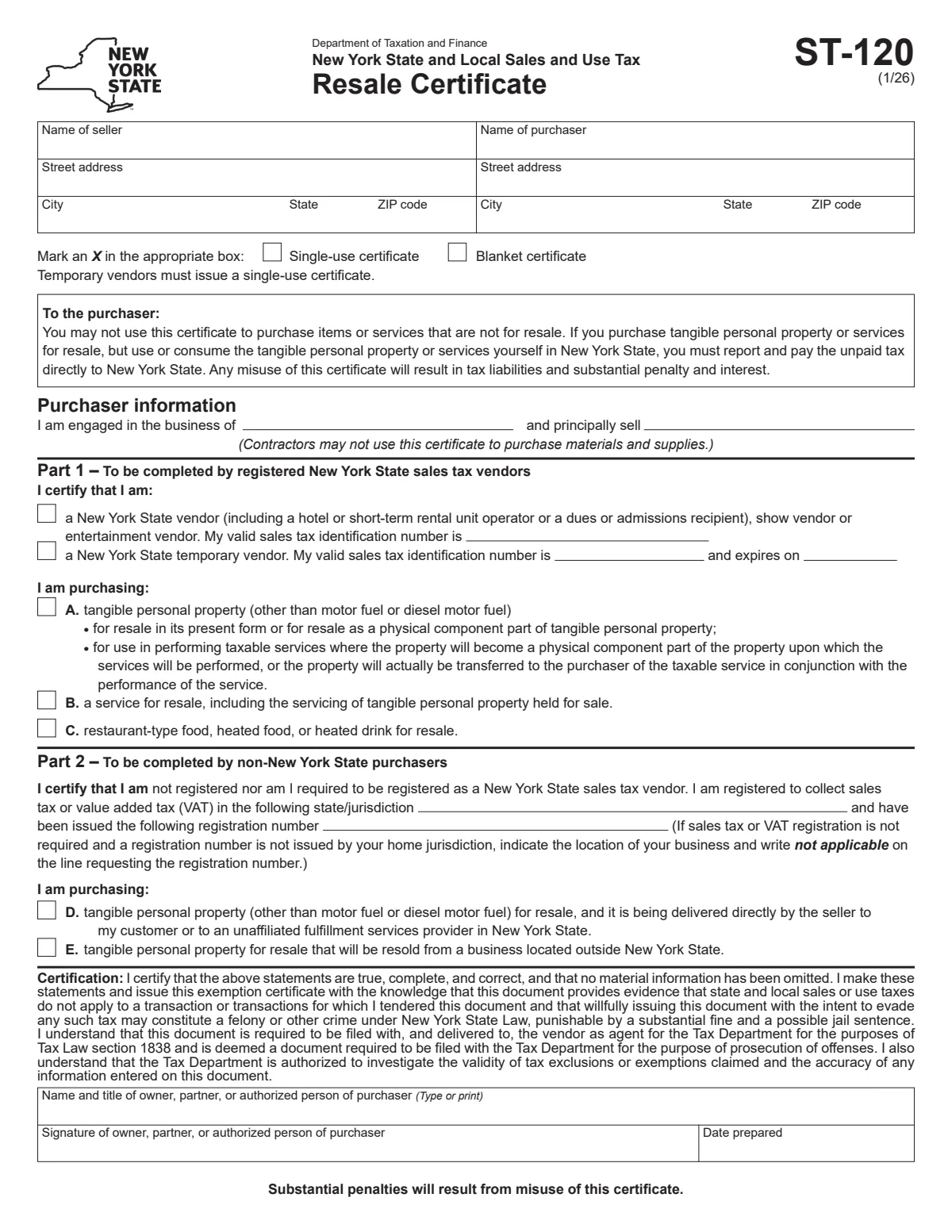
The parties and the box
The top of the form names both parties and sets the certificate's scope. The purchaser information line below it is where a seller first sees whether the purchase fits the buyer's business.
| Line | As printed | What goes there |
|---|---|---|
| seller | Name of seller, Street address, City, State, ZIP code | The vendor the buyer is buying from. The instructions say “Enter all the information requested on the front of this form.” A certificate missing an entry is not properly completed. |
| purchaser | Name of purchaser, Street address, City, State, ZIP code | The buyer. If the address or ID number on a blanket certificate later changes, “you must give your seller an updated blanket certificate.” (TB-ST-240). |
| type | Mark an X in the appropriate box: Single-use certificate, Blanket certificate | “You may mark an X in the Blanket certificate box to cover all purchases of the same general type of property or service purchased for resale.” “If you do not mark an X in the Blanket certificate box, the certificate will be deemed a Single-use certificate.” “Temporary vendors may not issue a blanket certificate.” |
| business | Purchaser information: I am engaged in the business of ... and principally sell ... | Two short entries: the line of business and the main goods or services sold. The seller compares them with the purchase. The printed note under the line: “(Contractors may not use this certificate to purchase materials and supplies.)” Contractors use Form ST-120.1 or a direct payment permit, or pay the tax. |
Part 1: registered New York vendors
A buyer registered in New York completes Part 1 only: one of the two identity boxes, then A, B or C for what it is buying.
| Line | As printed | What goes there |
|---|---|---|
| P1-vendor | Part 1: To be completed by registered New York State sales tax vendors. I certify that I am: a New York State vendor ... My valid sales tax identification number is | The usual line for a New York buyer. The number is the identification number on its Certificate of Authority; the form is for a buyer that “is registered as a New York State sales tax vendor and has a valid Certificate of Authority issued by the Tax Department”. A seller can check registration with the Department's Registered Sales Tax Vendor Lookup. |
| P1-temp | a New York State temporary vendor. My valid sales tax identification number is ... and expires on ... | A temporary vendor is one “who, in no more than two consecutive quarters in any 12-month period, makes sales of tangible personal property or services that are subject to tax.” It enters its number and expiration date and must issue a single-use certificate. |
| A | A. tangible personal property (other than motor fuel or diesel motor fuel) | The usual resale box. It covers property for resale in its present form or as a physical component part, and property used in performing taxable services where it becomes a physical component part of the property serviced or is transferred to the service customer. Motor fuel is excluded: “This certificate may not be used to purchase motor fuel or diesel motor fuel.” |
| B | B. a service for resale, including the servicing of tangible personal property held for sale. | For a registered buyer reselling a taxable service. Out-of-state buyers in Part 2 have no service box: TB-ST-190 says “A qualified out-of-state purchaser may not use Form ST-120 to purchase any taxable services for resale within New York State”. |
| C | C. restaurant-type food, heated food, or heated drink for resale. | For a registered buyer reselling food of the kinds New York taxes as restaurant-type or heated food. |
Part 2: buyers not registered in New York
Part 2 is for a buyer that is neither registered nor required to register in New York. It covers goods only, in two situations, D and E. TB-ST-190 calls such a buyer a qualified out-of-state purchaser and notes it “can also use Form ST-120 to make tax-exempt purchases of tangible personal property for resale.”
| Line | As printed | What goes there |
|---|---|---|
| P2 | Part 2: To be completed by non-New York State purchasers. I certify that I am not registered nor am I required to be registered ... | Enter the state, province or country of registration and the number. If the home jurisdiction does not register sellers, the form says to “indicate the location of your business and write not applicable on the line requesting the registration number.” A business that meets New York's registration rules cannot use Part 2; the instructions warn of a penalty “of up to $500 for the first day on which you make a sale or purchase, and up to $200 for each additional day, up to a maximum of $10,000.” |
| D | D. tangible personal property (other than motor fuel or diesel motor fuel) for resale, and it is being delivered directly by the seller to my customer or to an unaffiliated fulfillment services provider in New York State. | The drop shipment box. Delivery by the seller “includes delivery in the seller’s own vehicle or by common carrier, regardless of who arranges for the transportation.” |
| E | E. tangible personal property for resale that will be resold from a business located outside New York State. | For an out-of-state reseller that picks up or receives goods in New York and resells them from its business elsewhere. |
Certification and signature
| Line | As printed | What goes there |
|---|---|---|
| cert | Certification: I certify that the above statements are true, complete, and correct ... | Nothing to enter. The buyer accepts that “willfully issuing this document with the intent to evade any such tax may constitute a felony or other crime under New York State Law”, and that the certificate is “required to be filed with, and delivered to, the vendor as agent for the Tax Department”. That is why it goes to the seller and not to the Department. |
| name-title | Name and title of owner, partner, or authorized person of purchaser (Type or print) | Who signs, and in what role. The certificate must carry “the purchaser’s signature, or an authorized representative’s signature” (TB-ST-240). |
| sign | Signature of owner, partner, or authorized person of purchaser | On paper, a handwritten signature. Electronic certificates are allowed: “Sales tax exemption certificates may also be issued and accepted electronically.” An e-certificate must reproduce all the language of the paper form plus the Department's electronic signature block (TSB-M-07(1)S). |
| date | Date prepared | The date. It helps the seller show the certificate was in hand within 90 days of the sale. |
The seller's side
The instructions to the seller: “If you are a New York State registered vendor and accept an exemption document, you will be protected from liability for the tax, if the certificate is valid.” Valid means three things:
- Good faith. “A certificate is accepted in good faith when a seller has no knowledge that the exemption certificate is false or is fraudulently given, and reasonable ordinary due care is exercised in the acceptance of the certificate.”
- In hand within 90 days. “When you receive a certificate after the 90 days, both you and the purchaser are subject to the burden of proving that the sale was exempt, and additional documentation may be required.”
- Properly completed. All required entries made. A late fix is allowed: “An exemption certificate received on time that is not properly completed will be considered satisfactory if the deficiency is corrected within a reasonable period.”
The seller must also tie each exempt invoice to the certificate on file and keep the certificate: Keep the certificate at least three years after the due date of the related return, or the filing date if later (ST-120); electronic certificates are allowed (TB-ST-240). For a blanket certificate, TB-ST-240 counts from the last sale: keep it “for at least three years from the due date of the sales tax return on which the last sale using the exemption certificate was reported.” A seller may also say no: “You have the right to refuse to accept an exemption certificate, even if it is correct and properly completed.”
Limits and mistakes
- Contractors. “Contractors cannot use this certificate.” They issue Form ST-120.1, a direct payment permit (AU-297), or pay the tax.
- Motor fuel and cigarettes. “This certificate does not exempt prepaid sales tax on cigarettes.” Motor fuel and diesel motor fuel are excluded from A and D.
- A Part 2 buyer buying services. Not allowed; it would make the buyer a vendor that must register (TB-ST-190).
- Using goods bought for resale. “If you purchase tangible personal property or services for resale, but use or consume the tangible personal property or services yourself in New York State, you must report and pay the unpaid tax directly to New York State.”
- Misuse. A penalty of 100% of the tax due, $50 for each fraudulent certificate, possible felony prosecution and revocation of the Certificate of Authority (ST-120). See misuse penalties by state.
- A blanket certificate after a change. A new address or ID number means a new certificate (TB-ST-240).
How it connects
- New York's rules, the Certificate of Authority and the other exemption certificates: New York resale certificate.
- Drop shipments into New York and other states: drop shipments. Buyers from other states: out-of-state resale certificates.
- Checking the buyer's registration: verify a resale certificate. Timing in every state: good faith and timing.
- Other form pages: California CDTFA-230, North Carolina E-595E, Michigan Form 3372.
Common questions
Does a New York ST-120 expire?
No set date. A blanket certificate stays in effect as long as the buyer keeps making exempt purchases from that seller, unless its address, ID number or other information changes (TB-ST-240).
Can a buyer from another state use the ST-120?
Yes, in Part 2, if it is not required to register in New York. A buyer not required to register in New York gives its home sales tax or VAT registration (Part 2), only for goods delivered to its New York customer or fulfillment provider, or resold from a business outside New York; not for services (TB-ST-190).
Can a New York seller accept another state's resale certificate or the MTC form?
No. TB-ST-240 says exemption certificates of other states or countries are not valid to claim exemption from New York State and local sales and use tax.
What if the certificate arrives more than 90 days after the sale?
The seller loses the automatic protection. Both the seller and the buyer then carry the burden of proving the sale was exempt, and more documentation may be required.
Can the ST-120 be signed electronically?
Yes. TSB-M-07(1)S allows e-certificates that reproduce all of the form's language and add the Department's electronic signature and certification block.
Sources
- New York State Department of Taxation and Finance, Form ST-120, Resale Certificate, ST-120 (1/26), with its instructions
- Tax Bulletin ST-240, Exemption Certificates for Sales Tax; Tax Bulletin ST-190, Drop Shipments
- TSB-M-07(1)S, Electronic Resale and Exemption Documents (March 1, 2007)